Regulation and margin demands drive next phase of post-trade automation, TT says
6th August, 2026
Increasing regulatory complexity and rising margin requirements are reshaping investment in post-trade technology, with firms seeking greater automation and real-time risk management to cope with growing operational demands, according to executives at Chicago-based fintech Trading Technologies (TT).
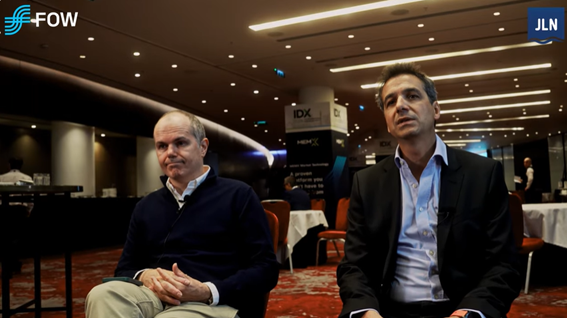
Speaking to FOW and John Lothian News at FIA's International Derivatives Expo (IDX) in London in June, David Romeo, vice president and managing director of ETD Clearing at TT (pictured, right), said regulation remained the dominant challenge facing clearing firms.
"Regulation, regulation, regulation," Romeo said in a video interview. "All our clients are facing a huge pressure from regulators. For the last 10 years, with Dodd-Frank, EMIR, MiFID, most recently with the DEMIST regulation put in place by the FIA, we have tried to help our clients in providing services to cope with all these new regulations."
Romeo added that the industry's technology model had also shifted significantly, with clients increasingly preferring fully hosted post-trade services rather than managing their own infrastructure.
"Clients can really concentrate on their main business," he said. "We provide full services from installation to market evolution."
Margin moves to the forefront
Maxime Jeanniard du Dot, senior vice president of margin analytics at TT (pictured, left), said regulatory reforms and heightened market volatility had made capital efficiency a priority for derivatives market participants.
"Our mission is really to allow derivatives traders to be more capital efficient when they trade those products," he said in a video interview.
He explained that the integration of OpenGamma, acquired by TT earlier this year, would allow traders to assess the margin implications of trades before execution while embedding margin analytics into post-trade clearing workflows.
"On a pre-trade basis you can see the margin impact of executing a certain trade on different exchanges," Jeanniard du Dot said. "On the post-trade basis, we're working really closely with the TT Clearing team to embed our analytics into the clearing workflows to increase the efficiency and the automation of those."
Romeo added that the firms had already launched new functionality allowing clients to optimise give-up workflows to reduce margin requirements before trades are allocated for clearing.
AI and automation
Executives also pointed to artificial intelligence as the next stage in post-trade automation, with TT planning to integrate AI into its trade matching platform before the end of the year.
"Obviously AI," Romeo said. "We use AI for the development cycle of all our projects. Next step is to integrate AI into our matching capabilities. This will be launched really quickly. By the end of the year, we'll be able to provide AI integrated into our matching tool."
He added that clients increasingly wanted straight-through processing, with operations teams focused on managing only exceptions rather than manual post-trade workflows.
"More and more STP clients want only to manage exceptions," Romeo said.
Jeanniard du Dot said upcoming regulatory initiatives, including FIA's Margin Efficiency Framework (MEF) 3.0 and the expansion of mandatory US Treasury clearing, would further increase demand for transparency around margin calculations and optimisation tools.
"US Treasury repos being cleared is going to be new for the industry," he said. "We will work with our clients to provide more transparency and optimisation around those margin requirements."
Preparing for 24/7 markets
Looking ahead, TT said it was also preparing for the gradual expansion of 24/7 trading across derivatives markets.
Jeanniard du Dot said the company's technology was already capable of supporting continuous trading, with the principal challenge shifting to operational support rather than system capability.
"24/7 is obviously coming," he said. "From a technology perspective, we're fully ready with that change."
The full video, produced as part of a series in partnership with John Lothian News, can be viewed here.
The comments follow another interview in FOW and John Lothian News' FIA IDX video series published last month, in which Oliver Deutschmann, EMEA head of equity derivatives at Liquidnet Europe, said the firm had seen growing interest in futures from investors that had not previously traded the products as firms sought faster ways to manage risk.
Related topics
Related Articles
All Insights18th September, 2026
TP ICAP opens new Belfast office
TP ICAP has opened a new office in Belfast with capacity for a further 150 jobs, as the interdealer broker marks ten years of operations in Northern Ireland.
Zak Jakubowski

18th September, 2026
UZEX, PhillipCapital partner to expand institutional access to global commodity futures
Uzbek Commodity Exchange (UZEX) has partnered with the Singapore-based brokerage firm to launch the joint venture ‘UZEX Global,’ granting the Central Asian country’s corporate clients access to international commodity futures via major exchanges like the CME Group, Intercontinental Exchange (ICE), and the London Metal Exchange (LME).
Aravind Bulusu
18th September, 2026
Energy traders turn to real-time data as AI reshapes commodities markets
Commodity and energy trading desks are increasing their use of real-time and alternative data as artificial intelligence allows firms to process larger datasets and respond more quickly to volatile markets, according to Burton-Taylor International Consulting.
Zak Jakubowski