Energy traders turn to real-time data as AI reshapes commodities markets
18th September, 2026
Commodity and energy trading desks are increasing their use of real-time and alternative data as artificial intelligence allows firms to process larger datasets and respond more quickly to volatile markets, according to Burton-Taylor International Consulting.
Speaking to FOW earlier this month, Burton-Taylor senior analyst Hadley Weinberger said firms have traditionally had less need for real-time information in commodity and energy markets than in equities, but that is beginning to change.
“A lot of what we've discovered in speaking with different people is that they're looking at a little more real-time data than they were before in these types of markets,” Weinberger told FOW in an interview. “Real-time data becomes more valuable combined with artificial intelligence. It’s giving you more up-to-date analysis of what's happening in the markets. Everyone wants real-time data.”
Weinberger said more timely information allows firms to identify market anomalies and feed more current inputs into analytical and predictive models.
“The more current information you have, the easier it is to identify market anomalies, capitalize on opportunities, and build stronger analytical and predictive models,” she said.
Volatility changes data requirements
Burton-Taylor research director Brad Bailey said the evolution towards real-time information has been particularly pronounced in derivatives, with futures and options markets providing immediate pricing signals and swaps becoming increasingly real-time.
But trading desks are also combining those prices with a broader range of physical and fundamental information as geopolitical disruption makes energy markets harder to navigate.
Bailey said periods of heightened geopolitical risk have produced unusual trading patterns, with bursts of positioning followed by periods when market participants hold back because of uncertainty.
“What we've seen from a trading and a hedging and a derivative perspective is intense volatility, yet at times, a lot of times people sitting on their hands,” Bailey said.
He said physical oil traders, for example, increasingly look beyond derivatives prices to information on supply disruptions and other fundamental factors when assessing market conditions.
The growing range of inputs includes satellite and sensor data alongside information on shipping movements, infrastructure and physical supply and demand.
Bailey said information on factors such as how deeply a vessel is sitting in the water can be combined with other datasets to help traders assess cargo movements and build a more detailed picture of energy supply.
The development is creating an increasingly interconnected commodities data ecosystem, with financial prices combined with physical information to generate trading signals and assess supply and demand.
Financial institutions return to energy
The shift comes as financial institutions increase their focus on commodities and energy markets.
Weinberger said the trend has been particularly evident in energy, where firms have increased staffing as volatility and demand for inflation hedging have supported revenues.
“Financial institutions are re-entering the commodities and energy sector, drawn by strong trading revenues from market volatility, the appeal of hedging against persistent inflation, and the chance to finance surging industrial demand tied to AI and the global clean energy transition,” she said.
“Strong revenues from the volatility and the hedging against inflation are leading them back into the sector.”
The findings form part of Burton-Taylor's latest commodities and energy research, which analyses market data supplier share, demand segmentation and spending by different types of financial institutions and trading desks. The research covers providers including S&P Global, Bloomberg, LSEG, Argus Media, ICE Data Services and Parameta Solutions.
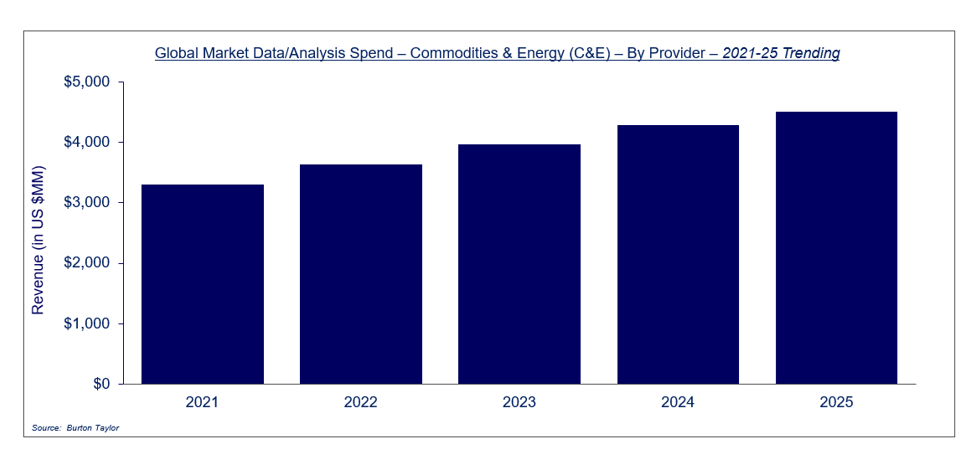
Worldwide spending on commodities and energy market data reached $4.5 billion in 2025 (see chart 1), up 5% year on year, according to Burton-Taylor. The Americas accounted for 52.3% of the total, compared with 28.5% for EMEA and 19.2% for Asia.
Chart 1:
Global market data spend – commodities & energy – 2021-25
Source: Burton Taylor
Demand has been supported by firms requiring data for risk models, trading curves, pricing models and independent price verification, alongside regulatory requirements and pressure on margins.
The research also points to demand for increasingly granular information, ranging from spot and benchmark indices used for physical settlement to real-time trade flows, capacity information and plant-level economic margin forecasts.
Burton-Taylor's report examines longer-term commodities and energy data spending, including a 15-year view of the market and spending growth relative to other business areas.
AI supports expansion into new markets
The growth of transition metals is also widening the range of information trading desks need to process as institutions enter markets where they may have less established expertise.
Weinberger said markets such as lithium create additional requirements for technology and analytics as traders familiar with established energy products expand into new commodities.
“As you expand into new markets, you'll need to invest in more technology and leverage artificial intelligence to enhance and improve your models,” she said.
She argued AI could shorten the process of building expertise in emerging markets by helping traders analyse new products and construct models more quickly.
“You may have a trader who has been trading oil for 10 or 15 years,” Weinberger said. “Now, with all these new technologies emerging, artificial intelligence can help them get up to speed, build and refine models, deepen their understanding of the market, support their trading decisions, and provide more actionable intelligence.”
Increasing computing capacity could further strengthen the predictive capabilities of commodity trading models as they consume a wider range of financial and physical information.
“The more computers can get, the more powerful these models will become,” Bailey said, pointing to advances in analysing weather, supply flows and demand.
FOW reported in June that global spending on financial market data reached $49.2 billion (£36.9 billion) in 2025, up 6.5% year-on-year, according to analysis by Hadley Weinberger, senior analyst at Burton-Taylor International Consulting, with real-time and trading data accounting for the largest share of expenditure.
Related topics
Related Articles
All Insights18th September, 2026
TP ICAP opens new Belfast office
TP ICAP has opened a new office in Belfast with capacity for a further 150 jobs, as the interdealer broker marks ten years of operations in Northern Ireland.
Zak Jakubowski

18th September, 2026
UZEX, PhillipCapital partner to expand institutional access to global commodity futures
Uzbek Commodity Exchange (UZEX) has partnered with the Singapore-based brokerage firm to launch the joint venture ‘UZEX Global,’ granting the Central Asian country’s corporate clients access to international commodity futures via major exchanges like the CME Group, Intercontinental Exchange (ICE), and the London Metal Exchange (LME).
Aravind Bulusu

18th September, 2026
NSE set to add sovereign interest rate derivatives from September 21
National Stock Exchange of India (NSE) said it will introduce cash-settled futures and options contracts on Government of India securities (G-Secs), with monthly and quarterly expiries beginning Monday, September 21.
Aravind Bulusu
