Liquidnet sees investors turn to futures as market volatility drives demand
27th July, 2026
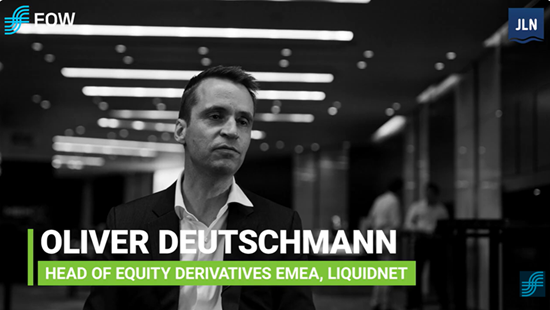
The shift towards listed derivatives highlights growing demand for liquidity as investors seek to reposition portfolios more quickly during periods of market uncertainty.
Speaking to FOW and John Lothian News during FIA's International Derivatives Expo (IDX) in London last month, Oliver Deutschmann (pictured), EMEA head of equity derivatives at Liquidnet Europe, said the firm had seen growing interest in futures from investors that had not previously traded the products as firms sought faster ways to manage risk.
"With all the volatility we're seeing in the market, speed is key,” Deutschmann said in a video interview. “That's where people get their positioning via futures, which is still the most liquid piece to trade. We're seeing a lot of inquiries there, even from people who haven't traded futures before, but need to hedge their overall positions."
He added that investors were increasingly expressing thematic views through index derivatives rather than individual stocks, allowing them to rotate more quickly between sectors.
"They want to be in fast, but out fast as well. If you do a portfolio trade of a bunch of stocks, it's hard to switch that around even within the day."
Europe faces liquidity challenge
Despite growing interest in European markets, Deutschmann said insufficient liquidity remained a key obstacle to attracting international institutional investors.
He said US-based clients had increasingly asked how they could build sizeable positions in European listed derivatives markets without materially moving prices.
"I'm interested in trading Europe, but how am I going to do it? How can I put on size? That's really the key question we're coming across."
Deutschmann suggested extending European trading hours could help attract additional order flow and narrow the liquidity gap with US markets. While weekday 24-hour trading would be operationally achievable, he said weekend trading would require additional risk management considerations.
"I don't see a reason why this shouldn't be possible, even in the near term. We need to do something attracting flow in Europe because the spread is just widening and widening."
AI increasingly used in pre-trade analysis
Separately, Deutschmann said Liquidnet was exploring how technology developed for its cash equities business could be applied to listed derivatives, including pre-trade analytics, algorithmic execution and post-trade workflows.
He said artificial intelligence had already transformed pre-trade analysis by automating tasks that previously required significant manual work.
"Five or six years ago the pre-trade analysis that we would be doing was so incredibly manual. AI can scan all this within a few seconds, even before you hit execute on a live order."
The full video, produced as part of a series in partnership with John Lothian News, can be viewed here.
The comments follow another interview in FOW and John Lothian News' FIA IDX video series published on Monday, in which Tobias Paulun, chief executive of European Commodity Clearing (ECC), said the clearing house would begin client testing of its new portfolio margining framework during the third quarter following regulatory approval.
Related topics
Related Articles
All Insights7th August, 2026
Options volumes on NSE, BSE decline over 50% during FY26 after SEBI crackdown
Indian exchanges saw 62.8 billion index options contracts traded in the FY 2025-26, compared to 131.4 billion lots during the previous financial year, due to measures taken by the regulator to curb excessive retail speculation in equity derivatives.
Aravind Bulusu

7th August, 2026
Blockchain.com secures VASP custody services license
The approval transitions the London-headquartered cryptocurrency exchange’s operations from conditional status to full integration within one of the world's leading offshore financial hubs.
Narayani Srinivasan

7th August, 2026
TAIFEX trading activity surges 74% in July
The Asian exchange reported higher derivatives trading volumes last month, driven by strong activity across its smaller-sized equity index and single stock futures.
Narayani Srinivasan