ECC to begin client testing of portfolio margining model in Q3 after regulatory approval
27th July, 2026
German-based European Commodity Clearing (ECC), the clearing house of EEX Group, will begin client testing of its new portfolio margining framework in the third quarter after securing regulatory approval, marking the latest step in its effort to improve capital efficiency for participants in Europe's energy markets.
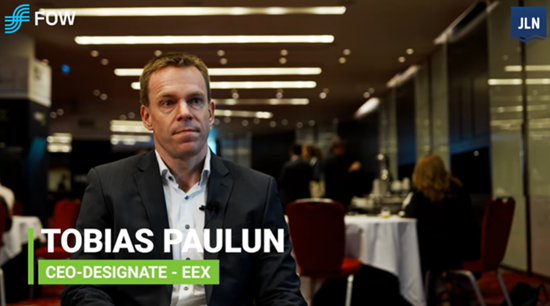
Speaking to FOW and John Lothian News on the sidelines of FIA's International Derivatives Expo (IDX) in London last month, Tobias Paulun, current chief executive officer of European Commodity Clearing (ECC) and soon to be chief executive officer of EEX, said the model would allow clients to test its impact on their own portfolios before a full rollout.
"We've announced that starting in Q3 this year, we will offer our clients the possibility to test the new portfolio margining system," Paulun said in a video interview. "When everyone is ready, we will move fully over to that new approach."
Paulun will assume the role of EEX chief executive on 1 August after serving as CEO of ECC since April 2023. He succeeded long-serving EEX chief executive Peter Reitz, who stepped down after leading the European energy exchange for 15 years.
The framework has already received regulatory approval and is now in the technical implementation phase, according to Paulun.
Margin efficiency has become an increasingly important issue for energy market participants as trading volumes and cross-asset portfolios have expanded, prompting ECC to invest in portfolio margining well before the recent bouts of market volatility.
"Looking at it from a portfolio perspective, the cross-margin across asset classes and considering all these portfolio effects has become of increasing importance for our clients," Paulun said.
Model proved resilient during market volatility
Paulun said ECC had tested the framework against periods of heightened volatility, including the sharp market movements experienced during March, with results meeting the clearing house's expectations.
"It was particularly interesting to see how the new model would have behaved under the heightened volatility that we've seen throughout March," he said. "The new model has proven very resilient."
According to Paulun, the framework is expected to reduce overall margin requirements while ensuring collateral is allocated more accurately to the areas of greatest risk.
"We see a reduction in margin requirements, but they are held in the accounts where they are most relevant. It's very tailored to the actual risk that clients have."
He added that the model also incorporates anti-procyclicality measures aimed at limiting sudden increases in collateral demands during periods of market stress.
Extended trading hours under consideration
Separately, Paulun said ECC is preparing to extend its operating hours as geopolitical events increasingly move commodity markets outside traditional trading sessions.
"Commodity prices don't stop moving just because an exchange is closed," he said. "Our goal is to increase transparency for those crises and provide our clients with the methods and possibilities for risk management that they need."
While 24/7 operations remain a longer-term ambition, ECC plans to extend clearing into the early European morning and later evening in consultation with clearing members and clients.
Paulun said recent market volatility had demonstrated the resilience of European energy markets compared with the energy crisis of 2022, with market participants better equipped to manage price swings following reforms introduced after that period.
The full video, produced as part of a series in partnership with John Lothian News, can be viewed here.
The comments follow another interview in FOW and John Lothian News' FIA IDX video series published on Tuesday, in which Simon Gallagher, chief executive of Euronext London and a member of the managing board of Euronext, said policymakers increasingly recognised that Europe faced a competitiveness challenge compared with other major markets.
Related topics
Related Articles
All Insights23rd October, 2026
Capital framework, tokenisation and AI key priorities: ISDA Japan Forum
ISDA’s chief executive officer spotlighted the progress being made across three key areas to bring greater efficiency to derivatives markets.
Karry Lai

23rd October, 2026
Underdog integrates Zerohash to unlock crypto, stablecoin funding
The sports prediction market has allowed accounts to be supported by stablecoins and digital assets, as an additional option.
Aravind Bulusu

23rd October, 2026
Uneven adoption of Basel III standards leaves Japan stuck in the middle: ISDA Japan Forum
The divergence in approach that jurisdictions are adopting on Basel III standards is creating challenges for banks, particularly for Japanese banks operating globally.
Karry Lai