TT chief on trading GPU - 'It is absolutely going to come'
18th June, 2026
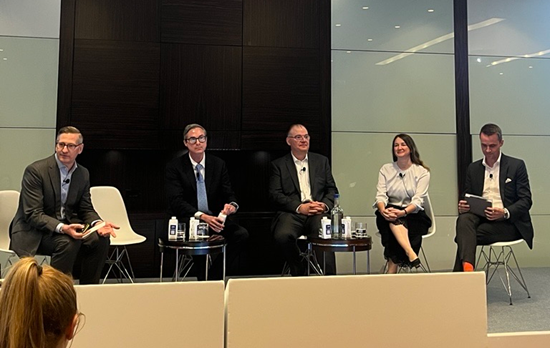
The growing use of artificial intelligence (AI) will force the derivatives industry to rethink how technology is priced, consumed and ultimately traded, with new markets likely to emerge around computing power.
Speaking on a panel at FIA's International Derivatives Expo (IDX) in London on Wednesday, Trading Technologies chief executive Justin Llewellyn-Jones said the costs associated with AI will increasingly become a focus for market participants and technology providers.
"We're all still paying our desk fee, that user fee for it. That is absolutely going to change because the costs associated with AI are going to become apparent over the next period," Llewellyn-Jones said on the panel. "The vendors are going to have to start working out how to pass on this part."
Looking further ahead, he predicted entirely new markets could emerge around AI infrastructure.
"I think the other innovation that's going to happen in our markets, in our futures markets, is we will work out how to trade GPU. It is absolutely going to come," Llewellyn-Jones said. "We will need to hedge it."
AI accelerates model development
Llewellyn-Jones said AI is already transforming how trading strategies are developed and refined.
"What we're going to see as we go forward is that the millions of data points that we use today to model an algorithm become tens of millions, hundreds of millions of data points," he said. "That time that it takes today to go from a hypothesis to an observation to an algo signal is going to shrink from months and weeks to days and hours.
"It is capable of ingesting a vast amount of data, not just structured data. It's capable of ingesting unstructured data, that sentiment-based data, the Federal Reserve notes, the shipping satellite image out of the Strait of Hormuz in real time into that modelling engine."
Llewellyn-Jones said AI is also changing how execution algorithms interact with markets.
"If you surround those benchmark algorithms with agents and those agents have the power to consume real-time data, you now have a very, very powerful engine that can insert data in real time," he said.
At the same time, he said some firms are already seeing significant productivity gains from agentic AI frameworks.
Human judgement remains critical
Despite advances in AI, panellists stressed that humans remain responsible for trading decisions.
"I don't want to make one thing clear before I finish. The idea of an agent making a trading decision is not something that TT is propagating," Llewellyn-Jones said. "I actually don't believe anyone in the industry right now is saying we would allow agents to make trading decisions.
"You need to have observability. There needs to be a deterministic set of constructs that if a regulator walks through the door and says, 'How did you make that trading decision?', what you can't do is say that the agent on the computer made it for me and I have no idea why."
Vassiliki Veliou, managing director at CMT Capital Markets Trading, said traders continue to play a central role in execution decisions.
"For us, human judgement really is important," Veliou said on the panel. "We have these discussions each day. Do we trust the machine or do we trust the trader? Sometimes the machine is allowed to win, but mostly the trader has the better feel for the market."
Oliver Deutschmann, EMEA head of equity derivatives at Liquidnet Europe, said periods of market stress often expose the limitations of models.
"The question is always, am I still in control here?" Deutschmann said on the panel. "I don't really trust the model if the assumptions the model is making are breaking down."
Not every AI project succeeds
Llewellyn-Jones said some firms have already scaled back AI initiatives after finding they produced inferior results.
"On Monday I was at a client of ours and they have rolled back some of the technology innovation that they've put in place over the last six months because the modelling result that they were getting was worse using AI than it was prior to the application of AI," he said.
"AI is still a nascent technology, and there are still hallucinations, and there is still an unpredictability about it," Llewellyn-Jones added. "There is still not quite yet that deterministic framework that systematic traders need."
FIA president and chief executive Walt Lukken said in his opening remarks at the 2026 IDX event on Monday that "global investment in artificial intelligence (AI) is measured in hundreds of billions of dollars, while distributed ledger technologies (DLT) are reshaping trading and settlement models".
Related topics
Related Articles
All Insights16th September, 2026
DTCC Fund/SERV adds Ondo as first tokenisation member
The Depository Trust & Clearing Corporation’s (DTCC’s) Fund/SERV platform has added Ondo Finance subsidiary Oasis Pro Markets as its first tokenisation member, creating a link between tokenised investment funds and traditional US fund distributors.
Zak Jakubowski

16th September, 2026
LME to launch electronic copper options in March 2027
The London Metal Exchange will launch electronic copper options trading on LMEselect on March 30, 2027, as the exchange moves ahead with plans to modernise its options market.
Zak Jakubowski
16th September, 2026
Fastmarkets taps TMX Trayport for lithium market infrastructure
The commodity price reporting agency is extending its role in lithium from benchmark pricing into the market infrastructure used to discover prices and initiate physical trades, with TMX Trayport providing the technology for that expansion.
Narayani Srinivasan