Banks expect mainframes to handle growing AI workloads - study
13th August, 2026

Banks expect mainframe computers to remain at the heart of their technology infrastructure as artificial intelligence adoption accelerates, with most technology executives saying AI will not challenge their existing reliance on the systems, according to Crisil Coalition Greenwich.
Crisil Coalition Greenwich on Thursday said 71% of bank chief information officers, chief technology officers and other technology executives surveyed believe AI deployment will not challenge their use of existing mainframes.
“Most CIOs/CTOs will retire before any mainframe plans are fully abandoned, and the question of balancing mainframe use versus the cloud will be inherited by millennial and Gen Z professionals,” David Easthope, senior analyst in market structure and technology at Crisil Coalition Greenwich and author of the report, said in a release. “Despite the bullet-proof nature of mainframe computing, the future of the banking industry is undoubtably a hybrid environment in which mainframes and cloud computing coexist and support different workloads.
“Banks will continue to modernize core applications on mainframes, while using cloud infrastructure where it provides greater flexibility, speed or access to new capabilities like AI.”
More than half, 54%, also believe next-generation mainframes can handle increasing AI demands.
The findings come as financial institutions continue to invest heavily in technology and assess where increasingly demanding AI workloads should operate, while maintaining the resilience and security required for core banking systems.
More than 90% of executives surveyed said over half of their organisation's core banking applications still rely on mainframes, with deposits, loans and payments among the high-volume processes dependent on the technology. Global banks also use mainframes across areas including treasury, securities processing and some legacy investment banking applications.
Banks favour modernisation over migration
Rather than migrating banking applications to the cloud, banks are focusing on modernising applications that already run on mainframes.
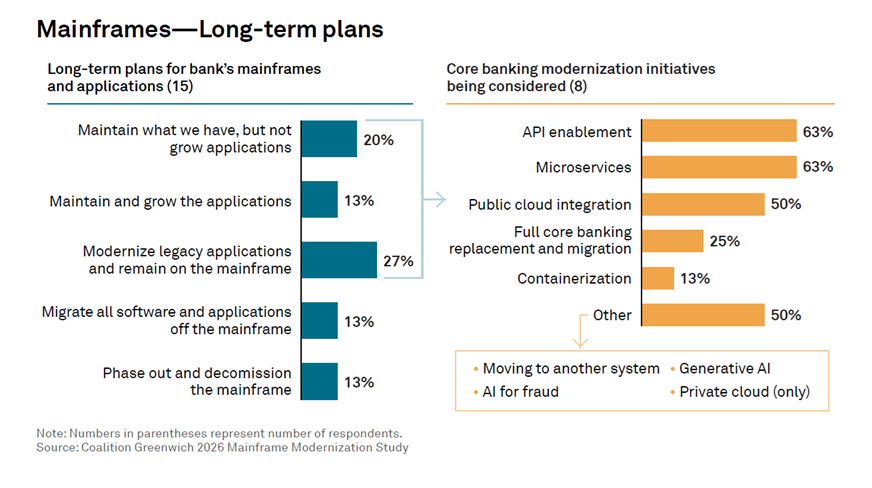
Crisil Coalition Greenwich found 27% of respondents plan to modernise legacy applications while remaining on their existing mainframe, while 20% plan to maintain their current applications without expanding them.
A further 13% intend to modernise legacy applications while expanding the use of mainframes, while the same proportion plan to migrate all applications off the technology (see Chart 1).
Chart 1: Mainframes-Long-term plans
Source: Crisil Coalition Greenwich
The research found banks continue to value mainframes primarily for resilience and dependability rather than their ability to deliver rapid technological innovation, describing the systems as “more tank than Ferrari”.
Banks assess where AI workloads should run
The growing adoption of AI is adding another dimension to banks' longstanding decisions over how workloads should be divided between mainframes, cloud infrastructure and other on-premise systems.
Crisil Coalition Greenwich said the debate has shifted beyond general questions around the cost, scalability and security of cloud and mainframe computing towards the more immediate issue of where AI workloads should operate.
Despite rapid advances in AI, most technology executives surveyed do not expect the technology to fundamentally challenge the role of existing mainframes.
The findings are based on interviews with 15 technology professionals at banks across North America, the UK and Europe. Crisil Coalition Greenwich examined the proportion of banking workflows operating on mainframes, banks' perceptions of the technology and their plans for balancing mainframe and cloud computing as AI adoption increases.
Separate Crisil Coalition Greenwich research in July, which found 87% of buy-side respondents consider fees important when selecting a clearing broker, while 84% cited operational processes and access to markets and products.
Related topics
Related Articles
All Insights28th September, 2026
ISDA flags tokenised collateral to support 24/7 derivatives trading
The International Swaps and Derivatives Association (ISDA) is working on a proof of concept for tokenised collateral as the derivatives industry considers how collateral and risk management would operate in a shift towards 24/7 trading.
Zak Jakubowski

28th September, 2026
LSEG joins Canton Network as Super Validator
London Stock Exchange Group (LSEG) has been appointed as a Super Validator on the Canton Network, expanding its role in the blockchain network as it develops digital cash settlement infrastructure for institutional markets.
Zak Jakubowski

28th September, 2026
Fragmentation a key challenge for APAC in tokenisation adoption: FOW Asia 2026
Without industry coordination, different regulatory frameworks make it difficult for market participants to agree on how to achieve collateral mobility and capital efficiency through tokenisation.
Karry Lai