World Bank, ISDA ink deal to build derivatives markets in developing countries
16th July, 2026
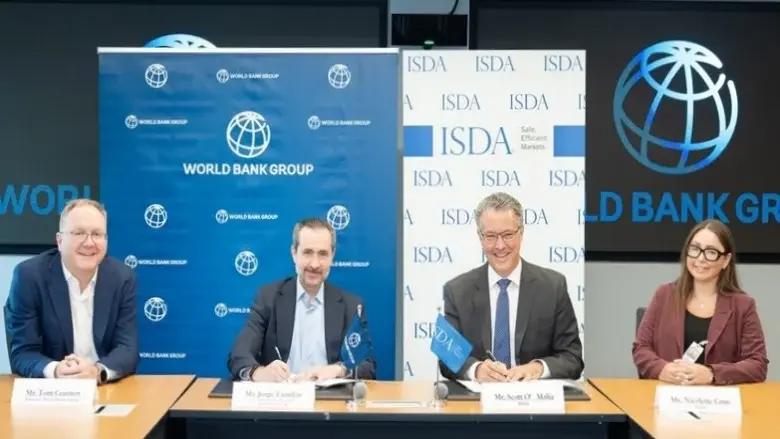
The collaboration aims to improve access to international derivatives markets in emerging markets, contributing to wider efforts to strengthen domestic capital markets across developing economies.
The International Bank for Reconstruction and Development (IBRD) signed a memorandum of understanding (MoU) with the International Swaps and Derivatives Association (ISDA) on Wednesday, formalising a shared focus on helping developing countries build the financial infrastructure needed to manage risk, attract investment, and finance sustainable growth.
World Bank Group institutions including the International Development Association, and the International Finance Corporation have also participated in the deal.
The latest development follows the New York-based trade body’s white paper published in February which highlighted the need to develop accessible and liquid derivatives markets in emerging economies to help banks manage their interest rate risk and lay the foundation for overall economic progress.
Jorge Familiar, vice president and treasurer of the World Bank Group, said in a release: “When countries have access to efficient derivatives markets, they can better manage the risks that come with borrowing, investing, and planning for the future. Working with ISDA brings global expertise and standards to the places where they are needed most.”
Well-functioning derivatives markets are essential for developing countries to hedge against currency and interest rate risks, access local currency financing, and integrate more effectively into global capital markets, the World Bank said.
Effective risk management helps private sector to mitigate against price volatility in supply chains by locking in prices, enhancing business confidence and supporting job creation.
"Robust derivatives markets require strong legal, regulatory and infrastructure foundations to be in place. Through this MoU, ISDA and the World Bank Group can help more countries build those foundations, deepen local capital markets and realise the benefits that effective risk management can bring to financial stability and economic development,” said Scott O'Malia, chief executive of ISDA.
IBRD also opined that emerging markets currently lack the legal, regulatory, and institutional foundations, including close-out netting frameworks and standardised documentation, that make these markets viable.
A 2023 ISDA survey found that 19 out of 44 surveyed emerging and developing economies have restrictions in place limiting the types of participants allowed to use derivatives.
The World Bank Group and ISDA said they will collaborate on policy dialogue, research and capacity building initiatives including workshops, seminars, and training programs on derivatives, risk management, standard ISDA documentation, market analyses, and public sector engagement.
The parties will meet periodically to coordinate activities and advance shared objectives under the MoU, IBRD said.
ISDA in October 2025 launched a new version of its Equity Derivatives Protocol to simplify the process of updating derivatives contracts, avoiding the time-consuming process of changing every single document by hand.
O’Malia in April highlighted the need to develop an onshore over-the-counter commodity derivatives market in India to allow domestic firms to manage global volatility more effectively, without undermining the existing exchange-traded market.
Related topics
Related Articles
All Insights14th October, 2026
Etrading Software, Adroit partner to streamline European fixed income data for buy-side
The London-headquartered technology provider has made its ETS Connect Plus dataset available within Adroit Trading Technologies’ execution and order management system (EOMS) to streamline fixed income workflows with real-time European bond data.
Aravind Bulusu

14th October, 2026
Abaxx Q3 volumes surge as exchange adoption grows
The Singapore-based exchange reported growing adoption for its contracts since its launch in 2024, driven by rising momentum in trading of its LNG and metal futures.
Narayani Srinivasan
14th October, 2026
WFE calls for sectoral European legislation to govern tokenised assets
The World Federation of Exchanges (WFE) said that crypto assets qualifying as financial instruments should be regulated under the Markets in Financial Instruments Directive/Regulation (MiFID/MiFIR) instead of the Markets in Crypto-Assets (MiCA) framework.
Aravind Bulusu