Oil markets may be mispricing post-crisis demand - expert
3rd June, 2026
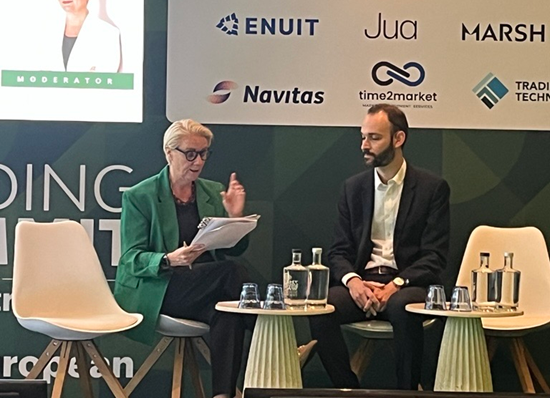
Oil derivatives markets may be underestimating the long-term impact of geopolitical disruptions on demand, according to a senior economist at French utility company ENGIE.
Speaking in a keynote interview at the Energy Trading Leaders Summit in Amsterdam on Wednesday, Julien Hoarau, head of economic research at ENGIE (pictured to the right) said geopolitics, climate change and power market imbalances had created an era of "structural volatility" across energy markets.
"What is clear for me right now regarding energy markets, that we have entered an era of structural volatility," Hoarau said. "Geopolitics clearly are one of the key pillars of this structural volatility.
"Every time in those conflicts there is a weaponisation of energy creating significant volatility, especially on the supply side, but also on the demand side."
Pricing long-term disruption
Hoarau said the oil market was currently reflecting the risk of a prolonged supply shock.
"If you see the Brent forward curve, we see that the market is pricing a relatively long disruption, because we used to trade around $70 (£52) per barrel before the military operation and if you look at the Brent forward curve, we find this $70 per barrel level at the end of the decade."
However, he argued that markets may be underestimating the longer-term impact on demand.
"My question is more about the long-term consequences of this crisis," Hoarau said. "Markets are underpricing that, meaning that after the crisis we may have lower oil demand than expected before the crisis."
The comments echo concerns raised at Eurex Derivatives Insights Asia in April, where panellists argued that markets were pricing inflation risks stemming from the Middle East conflict while underpricing the potential impact on economic growth. Marcus Liew, portfolio manager at Amundi, said at the time: "As markets today are pricing in inflation but underpricing growth risk, we've focused on a long position in the US five-year curve."
Hoarau pointed to Europe's experience following the 2022 energy crisis as evidence that demand destruction can persist after a major market shock.
"If you look at European gas demand in 2026, we are still more or less 15% below the pre-2022 price level," he said. "Meaning that part of this demand reduction can be permanent."
Despite the uncertainty, volatility continued to create opportunities for traders able to adapt.
"Volatility is key in energy trading," he added. "It creates clearly trade ideas, trader opportunities."
Hoarau said one of the clearest signs of structural change in European electricity markets was the growing frequency of negative power prices.
Asked whether extreme imbalance prices had become the new normal, he replied: "I think it's the norm right now... The market is sending us a signal that we need to invest in flexibility."
The growing pipeline of battery storage projects across Europe and regulatory changes in countries including France and Germany are increasingly aimed at managing renewable oversupply during periods of negative pricing, he added.
AI demand expectations carry risks
Hoarau also warned against growing optimism around artificial intelligence and data centre-driven energy demand growth.
"Clearly the consensus is quite optimistic regarding this," he said.
"There are many risks surrounding this AI shift. We are in an era of structural high interest rates in the US right now... We don't know exactly which revenues will be generated by all those investments."
Scenario planning becomes essential
Looking ahead, Hoarau said traders and investors needed to assess markets through multiple geopolitical, regulatory and climate scenarios rather than relying on a single outlook.
"We need to work with several scenarios, several layers of variables regarding geopolitics, regulation and climate," he said.
"The picture is more complex, but you need to cope with that, you need to adapt to that, and also carry an opinion and vision."
Speaking at the same conference on Tuesday, CME Group's Neil Somma said asset managers have become increasingly active since the 2022 energy crisis, helping to deepen liquidity, while European gas futures volumes have grown from around 300,000 contracts traded daily to more than 600,000.
Also at the event on Tuesday, Trading Technologies' Matt Racine described AI as "a huge accelerator" that allows traders to spend less time on execution and more time on research and strategy development.
Related topics
Related Articles
All Insights16th October, 2026
TFEX extends morning trading hours for currency, precious metal and rubber products
The exchange aims to enhance trading flexibility and enable investors to better manage risk and respond to global market movements.
Karry Lai

16th October, 2026
MIAX launches Tini B500 Index Futures and Tini B100 Index Futures on NinjaTrader
The contracts offer customers an alternative way to gain US equity exposure with smaller notional sizes, no exchange fees for retail traders and free market data.
Karry Lai
16th October, 2026
US options volumes remain moderate in Q3 amid macro headwinds
Listed options activity slowed down in the third quarter of 2026, easing back from a record Q2, as a decline in single stock options volume offset record trading in zero-days-to-expiration contracts.
Narayani Srinivasan