Lack of liquidity remains a challenge for tokenisation: ASIFMA conference
12th October, 2026
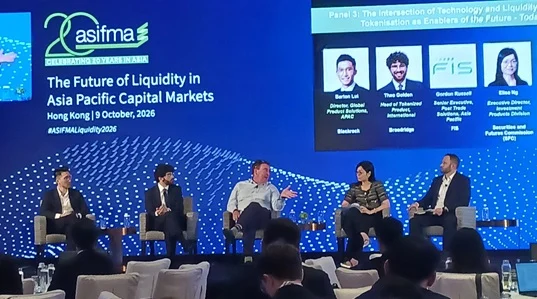
Market participants highlight the importance of legal certainty and interoperability to speed up investment into tokenisation.
Speaking at ASIFMA’s The Future of Liquidity in Asia Pacific Capital Markets conference in Hong Kong on Friday, panellists outlined key opportunities and challenges of building liquidity for tokenisation in the APAC region.
Barton Lui, director, global product solutions APAC, emphasised the importance of eligibility and regulatory certainty.
“Arriving at a common framework and legal certainty is the first step,” he said.
He noted that in jurisdictions like Hong Kong where tokenisation can be used as a wrapper, this is not necessarily the case in other jurisdictions.
“This complicates collateral postings and custody,” he said.
Theo Golden, head of tokenised product, international at Broadridge, believes that standard setting is a key inflection point for tokenisation.
In terms of legal interoperability, Golden said: “Just because a tokenised asset can freely move doesn’t mean it can move legally.”
He believes that emergence of tokenised funds has come first because asset managers are looking to further distribution and establish use cases for products.
“It’s efficient way for collective investment,” he said. “By creating a wrapper that’s more efficient than the underlying, tokenised funds offers a new investable process for treasuries and asset managers.”
The challenge will be to tokenise usefully and not add incremental costs.
Gordon Russell, senior executive, post trade solutions, Asia Pacific at FIS, said that the inflection point for tokenisation is that it has gone beyond sandboxing and getting meaningful investment is the next step.
“Getting liquidity is still challenging and while tokenised asset classes like real estate have picked up in jurisdictions like Japan, the lack of liquidity in the secondary market is stopping tokenisation from speeding up,” he said. “More investments are needed to introduce tokenisation into more mainstream instruments.”
He noted that market infrastructure is still evolving but with improved technology and connectivity between counterparties, the access to liquidity will speed up.
Elisa Ng, executive director, investment products division at Securities and Futures Commission discussed the initiatives that the regulator has taken to support tokenisation. These include a regulatory framework for the secondary trading of tokenised money market funds, facilitating international banks to launch regulated stablecoins and actively leading on Project Ensemble to shape tokenisation pilots.
“With 17 retail product launches accounting for assets under management of $1.3 billion, Hong Kong is the secondary trading pioneer for tokenised products in the region,” said Ng.
She noted the potential of tokenised money market funds in particular for their stability and they offer a good starting point for market participants to observe trading behaviour and for treasury management.
Speaking separately at the event, Sally Chen, resident representative Hong Kong at IMF, outlined key findings from IMF’s Scaling Tokenisation Report, highlighting that tokenisation issuance has increased fivefold in the last three years.
However, four constraints remain, namely legal certainty, interoperability, safe, sound and scalable settlement, as well as regulatory clarity.
“With a fragmented system, there’s a vicious feedback loop which limits liquidity and this deters tokenisation from scaling up,” she said.
Related topics
Related Articles
All Insights6th November, 2026
Eurex derivatives volumes jump 27% in October as rates trading surges 42%
Eurex reported 200 million derivatives contracts traded in October, driven by a sharp increase in interest rate activity, while OTC clearing volumes more than doubled and repo trading continued to expand.
Zak Jakubowski
6th November, 2026
EDX Markets adds BitSafe’s CBTC to expand institutional crypto trading
The institutional-only crypto exchange has launched spot trading for CBTC, BitSafe’s 1:1 Bitcoin token built for institutional use, marking the asset's first availability on a centralised exchange through a USD trading pair, with plans to introduce perpetual contracts in the coming weeks.
Aravind Bulusu

6th November, 2026
Kalshi launches US single-stock perpetual futures after CFTC approval
Kalshi has become the first US exchange to launch regulated single-stock perpetual futures, offering contracts linked to more than 50 companies just two days after Commodity Futures Trading Commission (CFTC) chairman Michael Selig announced that the products could begin trading on regulated US exchanges.
Zak Jakubowski