ISDA outlines ‘work to be done’ ahead of mandatory US Treasury clearing
12th June, 2026

With just 203 days left before the roll out of mandatory treasury clearing for cash transactions, the International Swaps and Derivatives Association (ISDA) has asked market participants to stay updated on different clearing models available from approved central counterparties
The global standard setting body organised the ISDA Treasury Forum on Thursday to discuss the far-reaching implications for market participants transacting in US Treasuries.
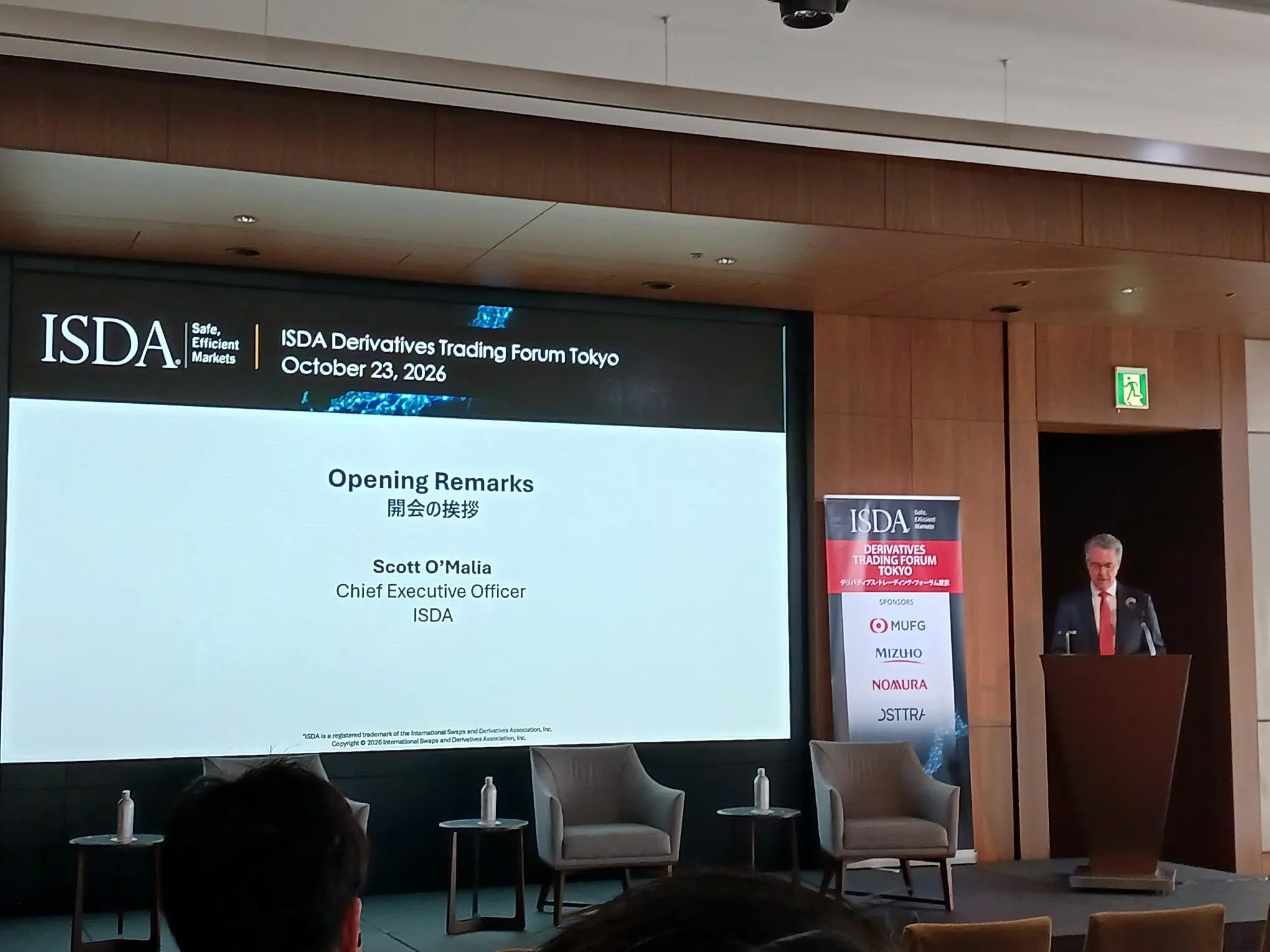
Scott O’Malia (pictured), chief executive of ISDA, said the implementation of mandatory US Treasury clearing is not one that firms can take lightly, although most firms are deeply committed to its success and are already well advanced in their preparations.
“As with other major market transitions—from the retirement of LIBOR to the rollout of non-cleared margin rules—successful implementation relies on diligent preparation and collaboration.”
The US Treasury market is the most liquid financial market, with outstanding issuance of more than $30 trillion (£22.3 trillion), he said, adding that US Treasuries are also widely used as collateral, which is vital for the smooth functioning of the derivatives market.
The ISDA chief said market participants should by now be up to speed with the different clearing models that will be available from the three approved central counterparties: Fixed Income Clearing Corporation (FICC), CME Securities Clearing and ICE Clear Credit.
“That means understanding the obligations for clearing members and clients, and the arrangements for collateral segregation, accounting and netting. ISDA has published a comparison of the different clearing models, which can be used as a reference point to support implementation.”
On client documentation, O’Malia said templates for done-with transactions, in which clients execute and clear with the same entity, have been ready for some time. “However, documentation for done-away transactions, in which different entities are used for execution and clearing, has been more challenging but is now very close to completion.”
With those templates nearly complete, firms must get on with the significant task of amending and updating their documentation with all their counterparties, he added.
Netting for client cleared repos
The standards body chief said ISDA now co-owns the client clearing documents with the Securities Industry and Financial Markets Association and is commissioning opinions in key jurisdictions outside the US to add the documentation to ISDA’s existing global opinions framework.
“These opinions will confirm the enforceability of netting for client cleared repos—a key requirement for banks as they scale their clearing operations globally. Commissioning the opinions within ISDA’s framework will ensure consistency and efficiency across markets.”
Regulatory framework
The US Securities and Exchange Commission (SEC) proposed to exempt transactions between two non-US entities that would otherwise be covered, with certain exceptions. ISDA is analysing the proposal, as well as potential amendments to the inter-affiliate clearing exemption, O’Malia said.
“We will continue to engage with regulators on these important issues as we seek appropriate solutions that maintain efficient access for all firms that rely on the US Treasury market, irrespective of their location.”
Cross-margining
ISDA chief said important progress has also been made on cross-margining, which is an important component of cleared markets. “By allowing firms to offset their margin requirements in a portfolio of Treasury cash, repo and futures transactions, cross-margining unlocks crucial efficiencies and ensures margin accurately reflects risk.”
The SEC and the Commodity Futures Trading Commission (CFTC) in April approved an exemptive order and proposed rule change to permit extension of the Fixed Income Clearing Corporation and CME Group cross-margining arrangement to clients.
“This is an important step forward in extending the substantial benefits of cross-margining to the broader market.”
However, O’Malia said there also needs to be recognition of offsetting risks in the US capital framework.
“Under the standardised approach for counterparty credit risk, banks must be able to realise the benefits of netting across repos and derivatives. Without this, they will be hit with inappropriately high capital requirements that will constrain their ability to provide liquidity in US Treasury markets.”
The latest Basel III endgame proposal is a step in the right direction, permitting cross-product netting, he said.
“This is an improvement on the original endgame proposal, but the methodology set out in the latest version is too conservative and lacks risk sensitivity. ISDA has been working to develop a recommendation for a more appropriate methodology that properly aligns capital with risk.”
Speaking at the forum, Agha Mirza, managing director, global head of rates and OTC products at CME Group, said: “Clearing is clearly more work and there are associated costs. But the industry is focused on the effort and progress is being made. There is an increase in voluntary sponsored clearing and the CME cross-margining arrangement with FICC is live for client clearing. The level of interest for that from clients is reminiscent of the move to SOFR products.”
Considering the systemic importance of US Treasuries, any change to the market structure needs to be implemented flawlessly from day one as there will be no second chances, O’Malia said, adding that ISDA will remain on hand to provide practical support and guidance on documentation, legal opinions and operational readiness.
Depository Trust & Clearing Corporation and CME Group in April secured regulatory approval to extend their US Treasury cross margining arrangement to end user clients, in a move aimed at improving capital efficiency across cash and derivatives markets.
Intercontinental Exchange in February said that it gained SEC approvals for US Treasury clearing service, opening the way for the exchange group to create an alternative to the current incumbent.
Related topics
Related Articles
All Insights23rd October, 2026
Capital framework, tokenisation and AI key priorities: ISDA Japan Forum
ISDA’s chief executive officer spotlighted the progress being made across three key areas to bring greater efficiency to derivatives markets.
Karry Lai
23rd October, 2026
Underdog integrates Zerohash to unlock crypto, stablecoin funding
The sports prediction market has allowed accounts to be supported by stablecoins and digital assets, as an additional option.
Aravind Bulusu

23rd October, 2026
Uneven adoption of Basel III standards leaves Japan stuck in the middle: ISDA Japan Forum
The divergence in approach that jurisdictions are adopting on Basel III standards is creating challenges for banks, particularly for Japanese banks operating globally.
Karry Lai