FIA chief sees cross-border cooperation as driver for derivatives growth
11th June, 2026

The trade association head said that unnecessary regulatory overlap can lead to market fragmentation, ultimately harming end users who rely on derivatives markets to manage risk.
Walt Lukken (pictured), president and chief executive officer of the Futures Industry Association (FIA), in a post on Wednesday, said that as derivatives trading today is increasingly global, with liquidity, there is a need for more cooperation from regulators multiple jurisdictions.
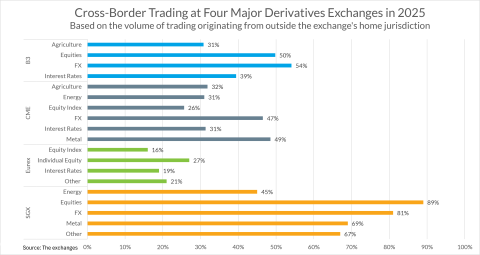
Lukken highlighted the increase in cross-border trading, based on data shared by four major global exchanges- B3, CME Group, Eurex and Singapore Exchange (SGX).
The data on the percentage of their trading volume that comes from outside their home jurisdiction showed that all the exchanges gain from cross-border exchange (see chart 1).
“The exact ratio varies by asset class, and some exchanges are more geared to international flows than others. But the bottom line is that end-users who come to these exchanges benefit from a deeper pool of liquidity. And that liquidity leads to more efficient markets and more cost-effective hedging,” said Lukken in the post.
Chart 1: cross border trading based on the volume of trading originating from outside the exchange’s home jurisdiction
Source: FIA
The data shared by CME Group showed that share of cross-border trading in the metals segment accounted for 49% and that of foreign exchange (FX) division was at 47%. The exchange also reported a significant share of cross-border trading across agriculture (32%), energy (31%), interest rates (31%) and equity index (26%).
In Eurex, the share of trading originating from outside the exchange’s jurisdiction was the highest in the individual equity segment at 27%. Interest rates (19%) and equity index (16%) segments have also benefited.
B3’s data showed that cross-border trading accounted for 54% of the exchange’s foreign exchange (FX) trading volume. The share of cross-border trading in the exchange’s equities segment was at 50%, interest rates (39%) and agriculture (31%).
SGX has been the major beneficiary of cross-border trading as witnessed across its equities segment at 89% and FX division at 81%. Other segments, including metals (69%) and energy (45%) also witnessed significant share of cross-border trading.
Highlighting this, Lukken said that when regulations overlap unnecessarily, conflict with one another or create duplicative requirements, market participants must deal with fragmentation. That fragmentation raises costs, reduces efficiencies and ultimately affects the end-users, he added.
He said cross-border markets function most effectively when the authorities respect one another's supervisory frameworks and focus on comparable regulatory outcomes. In his view, alignment on regulatory outcomes—rather than identical rulebooks—could reduce duplication while still maintaining standards for market integrity and financial stability.
“Ultimately, regulators have the same goals: protecting customers, promoting market integrity, reducing systemic risk and ensuring resilient market infrastructure. When they focus on outcomes, they create more space for markets to innovate and grow,” said Lukken.
Speaking to FOW in January, Lukken pointed to a transformation in regulatory approaches to new markets as a key catalyst for further growth in listed derivatives after a remarkable period of activity in the last year.
The World Federation of Exchanges (WFE) warned earlier this month that growing fragmentation in sustainability-related financial regulation is creating operational complexity, higher compliance burdens, and reduced comparability of sustainability data.
Related topics
Related Articles
All Insights23rd October, 2026
Capital framework, tokenisation and AI key priorities: ISDA Japan Forum
ISDA’s chief executive officer spotlighted the progress being made across three key areas to bring greater efficiency to derivatives markets.
Karry Lai
23rd October, 2026
Underdog integrates Zerohash to unlock crypto, stablecoin funding
The sports prediction market has allowed accounts to be supported by stablecoins and digital assets, as an additional option.
Aravind Bulusu

23rd October, 2026
Uneven adoption of Basel III standards leaves Japan stuck in the middle: ISDA Japan Forum
The divergence in approach that jurisdictions are adopting on Basel III standards is creating challenges for banks, particularly for Japanese banks operating globally.
Karry Lai