ESMA sees efficiency gains from stronger CCP supervision – IDX 2026
18th June, 2026
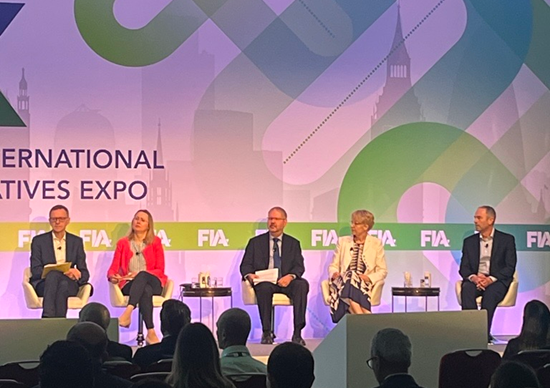
European regulators said stronger centralised supervision of central counterparties (CCPs) could improve efficiency and speed up decision-making, as policymakers continue work on reforms to the EU clearing framework.
Speaking at FIA's International Derivatives Expo (IDX) in London on Wednesday, officials from the European Securities and Markets Authority (ESMA), the Autorite des Marches Financiers (AMF) and the European Commission discussed the future of CCP supervision amid European market infrastructure reforms.
"Clearly there is an efficiency gain by not having two structures in parallel," said Klaus Loeber, chair of ESMA's CCP Supervisory Committee, on the panel. "There is potential to streamline here."
Patrice Aguesse, head of the market regulation division at the AMF, said centralised supervision would make it easier for regulators to respond during periods of market stress.
"It's always easier to have a quick answer to a market change, or even to a crisis, when you only have one single supervisor," Aguesse said on the panel. "There is a simplification to go straightforward, so it's a way to speed the decision. We definitely support having a single supervisor."
Simplification not deregulation
The panel also discussed broader efforts to simplify reporting requirements across European markets.
"Simplifying does not mean deregulating," said Anna Grochowska, deputy head of unit at the European Commission, on the panel. "We worked very closely with ESMA on transaction reporting rationalisation."
Aguesse said regulators are also seeking to reduce duplication across reporting regimes.
"The major objective for ESMA is to have what we call report once," he said. "You have to report to a regulatory body only one set of data with only one format."
Infrastructure and fragmentation
The discussion also turned to market infrastructure and the growing use of tokenised collateral.
"I see a strong risk that we run into a high degree of fragmentation," Loeber said. "We are talking not about the future, we are talking about now."
Loeber said clearing houses are already approaching regulators with proposals involving tokenised collateral and new infrastructure arrangements.
"It is important that we think about interoperability from the beginning," he said. "The objective should not be more fragmentation. The objective should be more efficient collateral movements."
Meanwhile, European exchange and clearing leaders on Tuesday cautioned against a rapid move to 24/7 trading, arguing that market quality, liquidity and collateral infrastructure remain more important than extending trading hours.
ESMA chair Verena Ross last month stressed the need to revisit the regulator’s rulebook on market integration, enhanced supervision and investor protection to ensure that it remains proportionate in a competitive economic environment.
Related topics
Related Articles
All Insights16th September, 2026
DTCC Fund/SERV adds Ondo as first tokenisation member
The Depository Trust & Clearing Corporation’s (DTCC’s) Fund/SERV platform has added Ondo Finance subsidiary Oasis Pro Markets as its first tokenisation member, creating a link between tokenised investment funds and traditional US fund distributors.
Zak Jakubowski

16th September, 2026
LME to launch electronic copper options in March 2027
The London Metal Exchange will launch electronic copper options trading on LMEselect on March 30, 2027, as the exchange moves ahead with plans to modernise its options market.
Zak Jakubowski

16th September, 2026
Fastmarkets taps TMX Trayport for lithium market infrastructure
The commodity price reporting agency is extending its role in lithium from benchmark pricing into the market infrastructure used to discover prices and initiate physical trades, with TMX Trayport providing the technology for that expansion.
Narayani Srinivasan