Derivatives data spending set to rise as firms invest in trading technology – study
6th October, 2026

Almost three quarters of financial firms expect to increase spending on derivatives market data as demand for real-time information, lower latency and AI-enabled trading workflows grows, according to Crisil Coalition Greenwich.
Around 73% of firms expect their spending on derivatives data to increase over the next 12 to 18 months, according to research published on Tuesday by London-based data and analytics provider Crisil Coalition Greenwich and Zurich-headquartered financial market infrastructure and exchange group SIX.
“The demand for new datasets continues to grow, driven by changing market structures and user needs,” the report said.
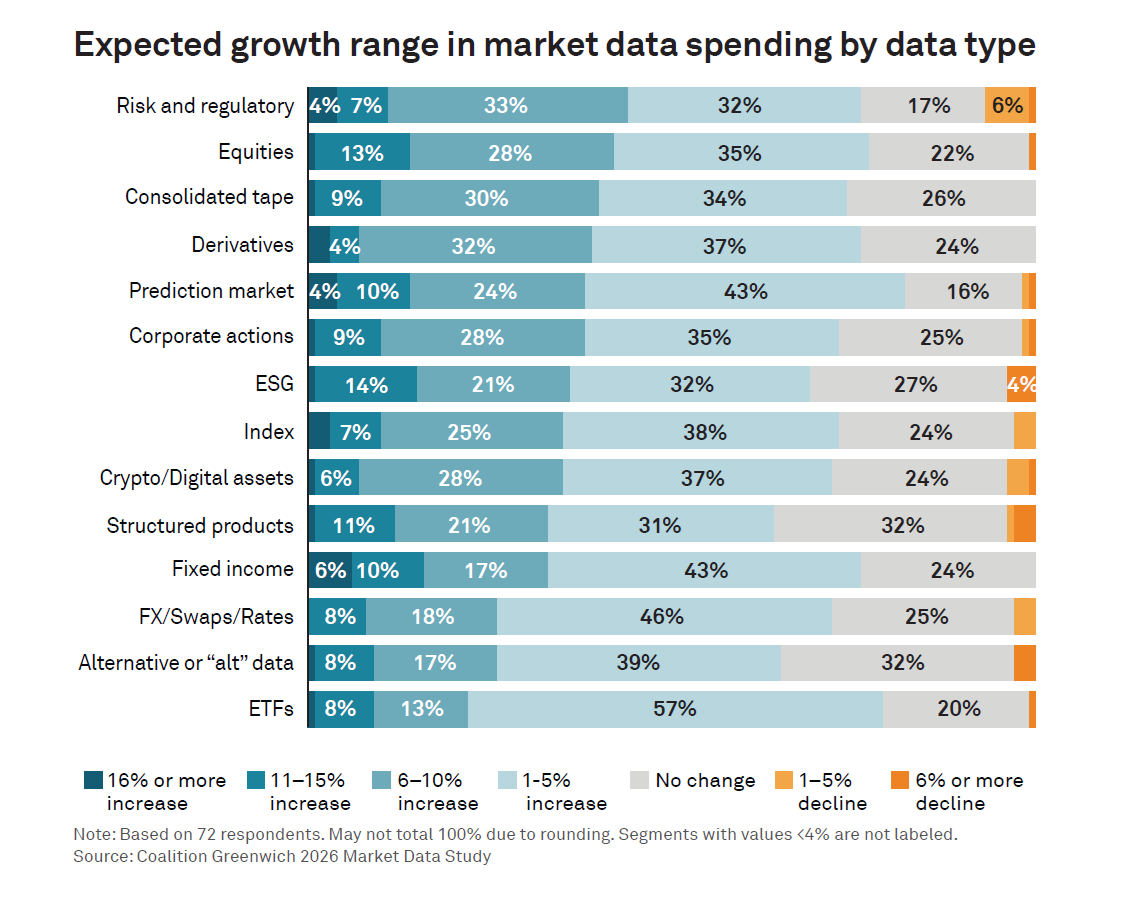
The study found 4% of respondents expect derivatives data spending to increase by 16% or more, while 32% anticipate growth of between 6% and 10% and 37% expect an increase of between 1% and 5%.
Around 24% expect spending on derivatives data to remain unchanged.
The findings echo recent research from Burton-Taylor showing energy and commodity trading desks are increasing their use of real-time data as artificial intelligence reshapes trading workflows. Burton-Taylor research director Brad Bailey told FOW the shift towards real-time information had been particularly pronounced in derivatives, with futures and options providing immediate pricing signals as firms combine financial prices with increasingly granular physical market data.
Derivatives data demand grows
Derivatives were among several data categories where respondents expect higher spending, alongside risk and regulatory data, consolidated tape data and prediction markets. The survey also showed expected increases across equities, crypto and digital assets, fixed income and FX, swaps and rates (see Chart 1).
Chart 1: Expected growth range in market data spending by data type
Source: Coalition Greenwich 2026 Market Data Study
The findings form part of a broader increase in market data investment, with 60% of respondents planning to raise their overall market data budgets as demand for higher-quality information, real-time delivery and AI-enabled workflows grows.
Crisil Coalition Greenwich gathered responses from 73 global buy-side and sell-side firms for the study, conducted in partnership with SIX.
The research surveyed 65 buy-side and eight sell-side firms across the US, UK and Europe between May and June, with most respondents working in front- and middle-office roles including portfolio management, trading, research and market data.
Real-time data demand grows
Trade execution remains the leading use case for real-time market data, cited by 67% of respondents, followed by risk and compliance at 59% and trade operations at 56%.
The study said demand for real-time information is also extending beyond the front office as markets expand their trading hours, including 23/5 trading environments in some asset classes.
“Prediction markets and weekend trading are prime examples of increased real-time data demand,” the report said.
Some 56% of respondents use real-time data throughout the day, with the study finding data frequency requirements are becoming more aligned across the trade lifecycle as real-time information expands into operations, risk and compliance.
Lower latency is also becoming increasingly important, with 78% of respondents willing to pay for faster data delivery, while 84% use streaming APIs.
Tick data is increasingly being deployed across trading and risk functions. Some 72% of respondents use tick data for market and trade surveillance, while 57% use it for transaction cost analysis and 51% for backtesting and trading strategies.
AI reshapes trading data requirements
The increased investment comes as financial firms expand their use of artificial intelligence across investment and trading workflows.
The research found 86% of respondents are using or evaluating AI in their investment and trading processes, while 40% are using predictive analytics to support decision-making.
Crisil Coalition Greenwich said data quality and transparency will be important to expanding the use of AI across trading and investing, with greater adoption expected to increase demand for real-time information.
Some 88% of respondents believe market data providers can help ensure the accuracy and reliability of AI as the technology becomes more embedded in investment and operational workflows.
The study also found 58% of respondents are considering or already engaged with Model Context Protocol (MCP), an open standard enabling AI applications to interact with data sources, applications and tools through a common interface.
Among respondents engaged with MCP, 57% are using or testing an MCP server. The report said the technology could simplify access to market data for AI applications, while raising questions around data licensing, derived data and the role of redistributors.
Crisil Coalition Greenwich said firms should invest in AI-ready data infrastructure while improving data quality, accessibility and usability, alongside targeting latency improvements where they are most important.
The findings follow separate Crisil Coalition Greenwich research in September showing derivatives were among the factors supporting increased US Treasury market activity, with nearly 4% of outstanding marketable Treasury debt trading each day in 2026 through August, up from roughly 3% in 2023. The consultancy cited a “robust derivatives market” alongside increased participation from non-bank market makers and dealer balance sheet capacity as factors supporting the rise in secondary-market turnover.