ANALYSIS: BSE’s derivatives journey and what lies ahead
20th May, 2026
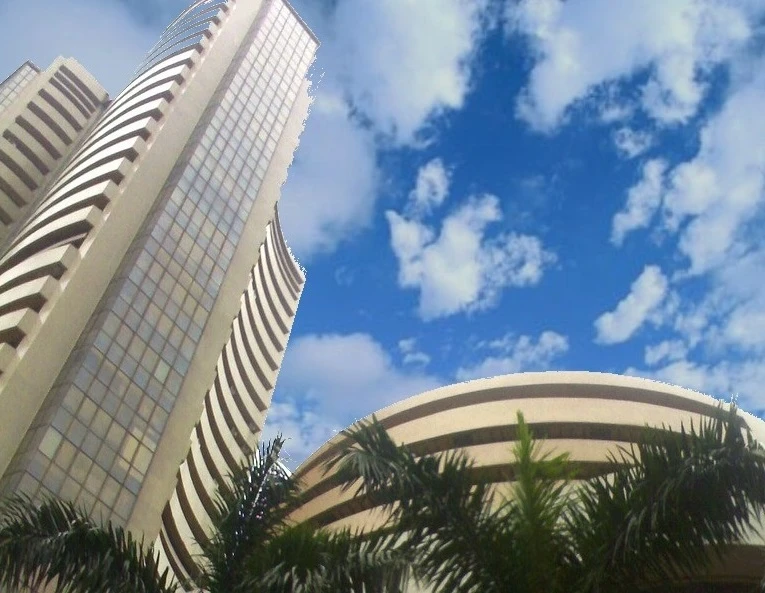
The chief business officer at Bombay Stock Exchange looked back at the exchange’s success with its SENSEX derivatives and how that can help inform future offerings.
Sunil Ramrakhiani, chief business officer at Bombay Stock Exchange (BSE), told FOW that for a prolonged period BSE’s presence in the equity derivatives market was marginal, leading to a change in approach.
“Despite being Asia’s oldest exchange, BSE was unable to establish meaningful liquidity in derivatives, with negligible volumes, limited broker participation, weak technology adoption and heavy dependence on monetary incentives that failed to deliver sustainable results,” said Ramrakhiani.
This lack of traction in a fast‑growing segment posed both strategic and reputational challenges for the exchange.
The turning point came in May 2023, when a clear strategic reset was undertaken with a sharp focus on customer voice, product differentiation, technology readiness and market structure reform.
“One of the earliest decisions was to discontinue unsustainable liquidity incentive schemes, shifting focus from subsidised participation to organic, structure‑led growth,” said Ramrakhiani.
Extensive engagement with brokers, proprietary trading firms, technology vendors and institutional participants revealed that success in derivatives required simplicity, predictability and execution efficiency, rather than incentives.
Based on these insights, BSE re‑launched its equity derivatives segment with a clear focus on index derivatives, beginning with SENSEX options and futures, followed by BANKEX derivatives and later single‑stock derivatives.
At the time of relaunch, derivatives participation at BSE was constrained by limited front‑end and vendor support. The exchange therefore worked closely with trading application providers, order management system vendors and brokers to enable rapid technical integration.
“This included onboarding of major vendors, enabling algorithmic strategies, and ensuring readiness across retail, institutional and proprietary desks,” said Ramrakhiani.
He continued: “Significant investments were made to scale system capacity, including expansion of partitions, introduction of message throttling frameworks, and strengthening of co-location infrastructure.”
These measures ensured that growth in volumes did not compromise system resilience, risk controls or market integrity.
As volumes scaled rapidly, BSE introduced a series of market structure and risk management enhancements to support orderly growth. These included the introduction of message throttling to manage peak loads, revision of expiry structures and settlement frameworks, the introduction of pre‑open session in equity derivatives, and strengthening of price protection and risk monitoring frameworks.
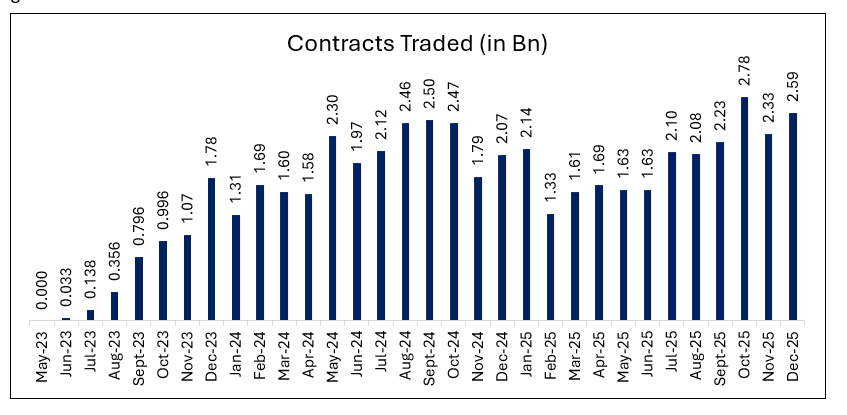
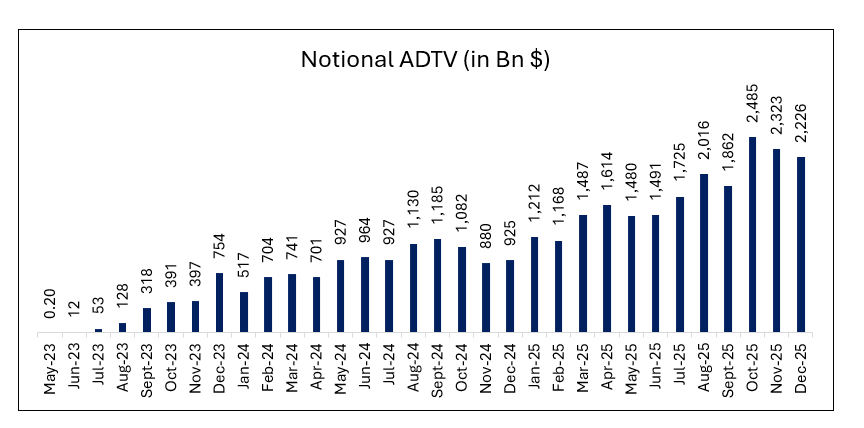
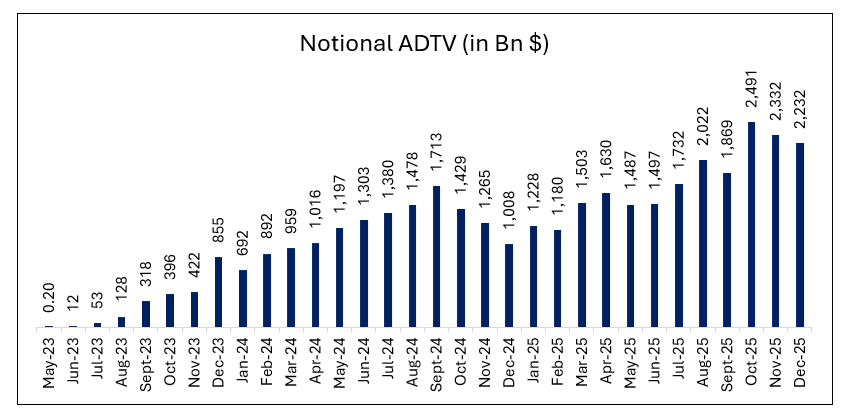
The results of this strategy were visible within a short span. From near‑zero activity, BSE’s equity derivatives segment scaled rapidly, achieving record levels of participation, premium turnover and contract volumes, particularly for its SENSEX derivatives (See Chart 1 and 2).
Chart 1: SENSEX derivatives volume on BSE
Source: BSE
Chart 2: SENSEX derivatives notional average daily volume on BSE
Source: BSE
SENSEX derivatives emerged as one of the fastest‑growing index derivative products globally, with strong participation from retail investors, proprietary traders, domestic institutions and foreign portfolio investors (FPI).
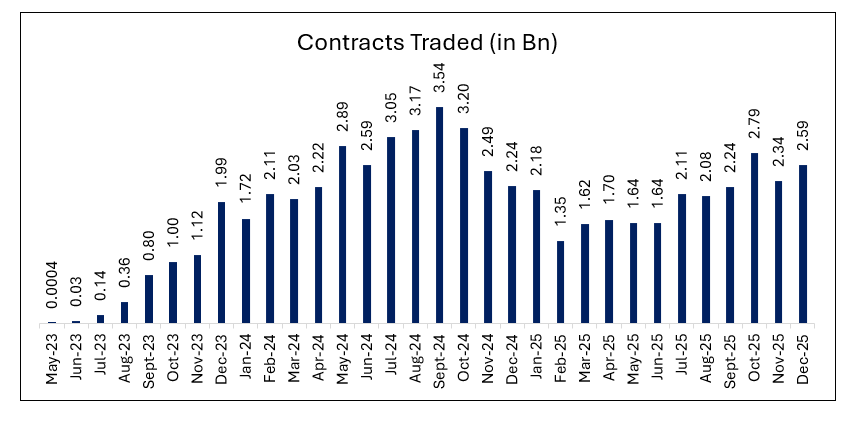
By FY25–26, BSE had achieved material market share in index derivatives by premium and contracts, expanded active derivatives membership significantly, and enabled deeper participation beyond expiry days into longer‑dated contracts (see Chart 3 and 4).
Chart 3 Derivatives contracts traded on BSE
Source: BSE
Source: BSE
The shift of index derivative expiry to Thursday further reinforced liquidity concentration and market relevance.
FPI participation increased from 73 in 2023 to 228 in 2024 and 468 in 2025 while unique clients went from 1.8 million in 2023 to 5.9 million in 2024 and 5.8 million in 2025.
"BSE’s derivatives journey continues to focus on depth over distortion, participation over incentives, and resilience over speed," said Ramrakhiani.
Ongoing efforts are directed towards broadening institutional participation, deepening non‑expiry day liquidity, strengthening risk frameworks, and expanding derivative offerings in a calibrated manner.
Related topics
Related Articles
All Insights2nd October, 2026
OptionMetrics says SPX 0DTE retail share at 30-35%
Retail investors account for an estimated 30% to 35% of zero-day-to-expiration SPX options trading, according to OptionMetrics, below estimates produced using Cboe’s proprietary methodology.
Zak Jakubowski

2nd October, 2026
StoneX to acquire Colombian coffee trader Integra
StoneX Group has agreed to acquire Colombian coffee trader and processor Integra Trading as the financial services firm expands its physical commodities business and coffee origination capabilities.
Zak Jakubowski

2nd October, 2026
CME September volumes rise 22% as Q3 hits record
CME Group reported record trading volumes in September and the third quarter, as interest rate, equity index and commodity derivatives recorded strong year-on-year growth.
Zak Jakubowski