24/7 derivatives trading hinges on collateral and liquidity – IDX 2026
18th June, 2026
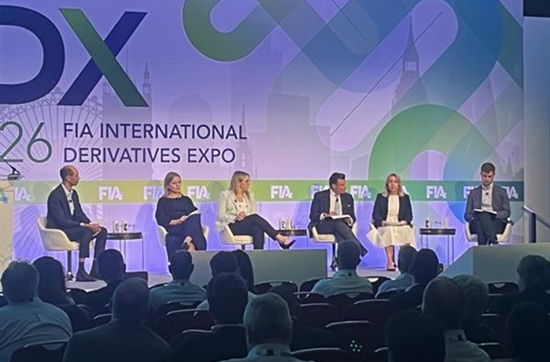
Clearing brokers, exchanges and infrastructure providers warned that collateral movement, liquidity and operational resilience remain significant obstacles to round-the-clock derivatives trading, despite growing momentum behind extending market hours.
Speaking at FIA's International Derivatives Expo (IDX) in London on Wednesday, panellists said that industry infrastructure around clearing, payments and risk management still needs to evolve to catch up to the technology that is already able to manage 24/7 trading.
"I think from a trading perspective, a lot of trading systems are really ready to support 24/7 markets," Markus Schmitz, head of cleared derivatives at FIS, on the panel. "I think the industry, more broadly, to adapt to markets clearing on a 24/7 basis, still have some way to go.
"Many firms are still on heritage batch based systems, so we need to move firms to next generation platforms that can run non-stop calculations and don't have end of day processing the same way as many systems do today."
Several panellists identified margin management and collateral mobility as the biggest challenges facing wider adoption of 24/7 trading.
"When we're thinking about 24/7 markets and continuous trading, continuous risk management is at the core of that discussion," said Helen Hartwell, EMEA head of clearing at UBS, on the panel. "As a member, we pre-fund in anticipation of trading over the weekend. There is a lag there between the trading and then the ultimate clearing."
Hartwell said the key issues are collateral mobility, real-time visibility and control from a risk management perspective and default management.
"How do we bring the transfer of margin closer to the trading life cycles?" she said. "What happens if there's a default over the weekend on a Saturday morning?"
Sebastian Jones, head of trading at Britannia Global Markets, said margin calls remain a major concern.
"We've seen markets go through one to two times the initial margin requirements in a matter of minutes," Jones said on the panel. "One of our concerns is margin calls."
Liquidity concerns
Liquidity was another recurring theme throughout the discussion.
"Liquidity concerns me," Jones said. "If we look at some liquidity across all markets, let's take the metals exchange, for example. Who's going to be providing prices for that?
"If you were to say to me, should we extend hours further today to the weekend, and is the liquidity available there? The answer is no."
Gemma Lloyd, chief operating officer EMEA at StoneX, warned against underestimating the impact of thinner markets.
"The liquidity dilution, potential liquidity dilution, shouldn't be ignored," Lloyd said on the panel.
Lloyd also said continuous clearing presents a greater challenge than continuous trading.
"Twenty-four hour trading doesn't keep me up as much as 24 hour or seven days a week clearing," she said. "If you've been through a major event from an operational point of view, whether that's back office systems going down, or whatever the reason, sometimes that weekend acts as the light at the end of the tunnel."
CME outlines current model
Kate Hughes, executive director of risk management at CME Group, said the exchange's current approach relies on strict pre-funding and continuous monitoring.
"We take very serious risk management around 24/7," Hughes said on the panel. "Clearing firms today have to be approved to go 24/7, so there's no concept of grandfathering in. There is a full due diligence that we do on any member that is looking to support the activity."
Hughes said CME requires firms to pre-fund anticipated weekend activity and provide additional liquidity reporting.
"Clearing firms are required to pre-fund any potential activity over the weekend," she said.
Looking ahead, Hughes pointed to tokenisation and digital assets as potential solutions.
"We're very much actively speaking with clearing member groups, customers, market participants about where we want to be on a 24/7 basis and what movement of value will ultimately look like on a 24/7 basis," she said. "We've also announced that we are looking at potentially launching a CME stable coin, which would potentially support value on a 24/7 basis."
The comments came as European exchange and clearing leaders on Tuesday cautioned against a rapid move to 24/7 trading, arguing that market quality, liquidity and collateral infrastructure remain more important than extending trading hours.
Related topics
Related Articles
All Insights16th September, 2026
DTCC Fund/SERV adds Ondo as first tokenisation member
The Depository Trust & Clearing Corporation’s (DTCC’s) Fund/SERV platform has added Ondo Finance subsidiary Oasis Pro Markets as its first tokenisation member, creating a link between tokenised investment funds and traditional US fund distributors.
Zak Jakubowski

16th September, 2026
LME to launch electronic copper options in March 2027
The London Metal Exchange will launch electronic copper options trading on LMEselect on March 30, 2027, as the exchange moves ahead with plans to modernise its options market.
Zak Jakubowski

16th September, 2026
Institutional digital asset sentiment rebounds despite market structure gaps- Acuiti
Institutional sentiment toward digital assets rebounded in the third quarter, even as firms continue to face gaps in market infrastructure, liquidity and regulation that could constrain the sector’s expansion, according to research from Acuiti.
Narayani Srinivasan