Treasury perpetual futures face liquidity test as CME and FMX rivalry grows
4th November, 2026

Proposed perpetual futures linked to US Treasury yields could eliminate the need to roll contracts, but attracting institutional investors away from established futures markets remains a significant challenge, according to Crisil Coalition Greenwich.
Kevin McPartland, head of research for market structure and technology at Crisil Coalition Greenwich, told FOW that while the products could appeal to investors seeking continuous exposure, existing Treasury futures benefit from deep liquidity.
"Traditional futures are so deep and liquid that it will take a compelling use case to move anybody into something new," McPartland said.
The comments follow Kalshi's filing for a perpetual futures contract tracking the 10-year US Treasury yield, with the Commodity Futures Trading Commission (CFTC) expected to provide guidance by the end of November.
Unlike traditional futures, perpetual contracts have no expiry date, allowing investors to maintain exposure without rolling positions into later-dated contracts.
"I think that's the primary reason from an institutional perspective: taking out the roll," McPartland said.
"Some investors are looking for that exposure in perpetuity, given their strategies, and the ability to adjust that exposure over time without regard to when the contracts need to roll."
However, he questioned how quickly institutional investors would adopt the products.
"Markets like this are generally not quick to change and adapt, even if new solutions appear on paper to provide a better mousetrap in some situations," he said. "It is a benefit on paper. Whether that plays out in the real world remains to be seen."
The comments come as research published by Crisil Coalition Greenwich in October found that 40% of institutional market participants expected perpetual futures to benefit traditional futures markets over the long term, while regulatory uncertainty remained the biggest obstacle to wider adoption in the US.
CME and FMX compete for Treasury futures liquidity
The proposed contracts come as CME Group faces growing competition from FMX Futures in US Treasury and Secured Overnight Financing Rate (SOFR) derivatives.
McPartland said FMX had made progress in SOFR futures, although building liquidity in Treasury contracts would take longer.
"They have made good progress, particularly in SOFR futures. Treasuries are still quite new," he said.
"It is a big hill to climb on the futures side. CME's open interest and volume speak for themselves, but FMX has made it clear that it is committed and has seen its open interest grow slowly but steadily," he said. "I think this is a years-long story. The market appreciates competition because it ultimately creates a better marketplace for everybody."
Both exchanges are also developing basis trading solutions intended to strengthen connections between cash Treasury and futures markets.
"If you're operating markets in futures and cash, then linking them in a way that helps traders makes sense," McPartland said. "The basis trade itself, which can be measured in a few ways, is hovering around a trillion dollars."
He said the initiatives could improve transparency and liquidity in a market where cash Treasury and futures activity are closely connected.
"Those two exchanges are pursuing that opportunity and trying to provide better solutions, greater transparency and perhaps better liquidity for that trade," he said.
Record Treasury volumes support futures growth
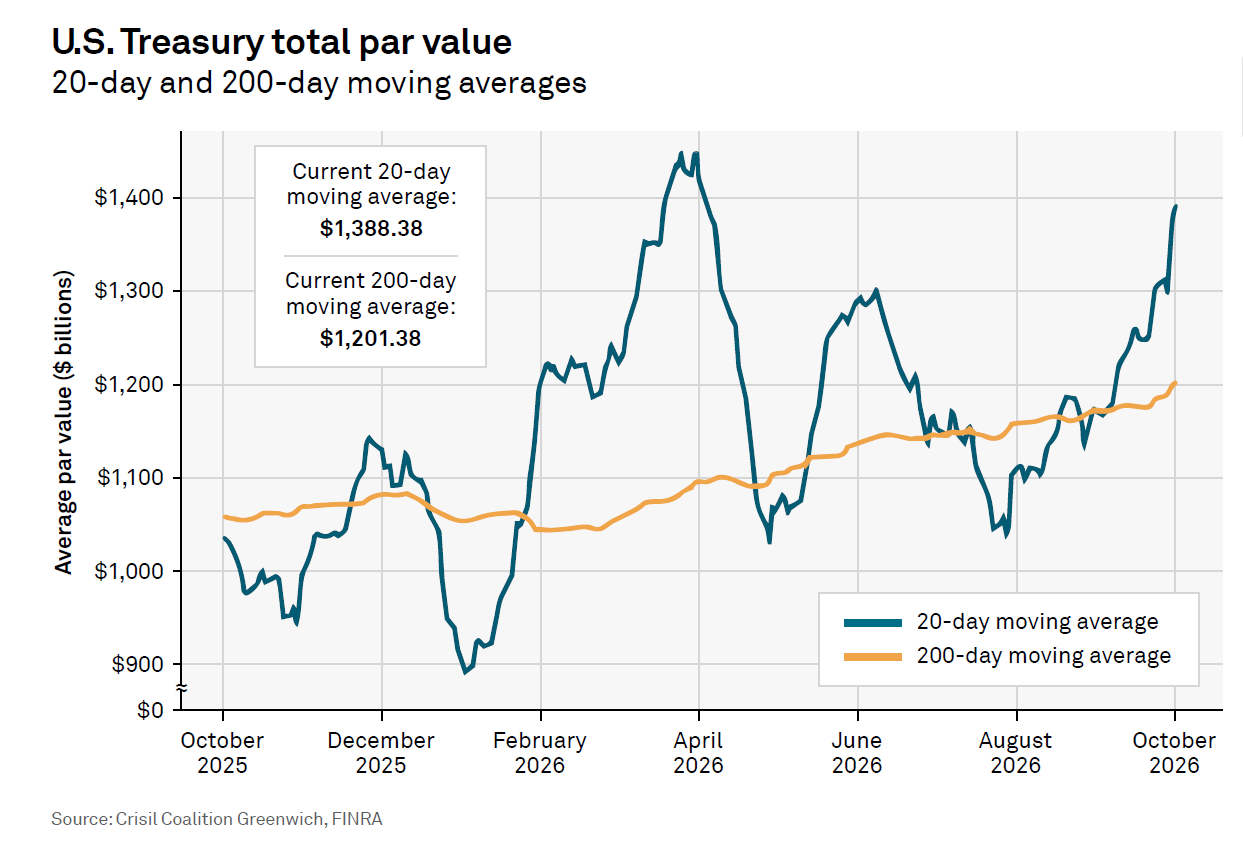
US Treasury trading reached record levels in September, with the 200-day moving average of daily volume hitting $1.2 trillion, according to Crisil Coalition Greenwich.
The 20-day moving average also reached approximately $1.39 trillion at month-end, approaching its earlier peak (see chart 1).
Chart 1: US Treasury total par value – 20-day and 200-day moving averages
Source: Crisil Coalition Greenwich/FINRA
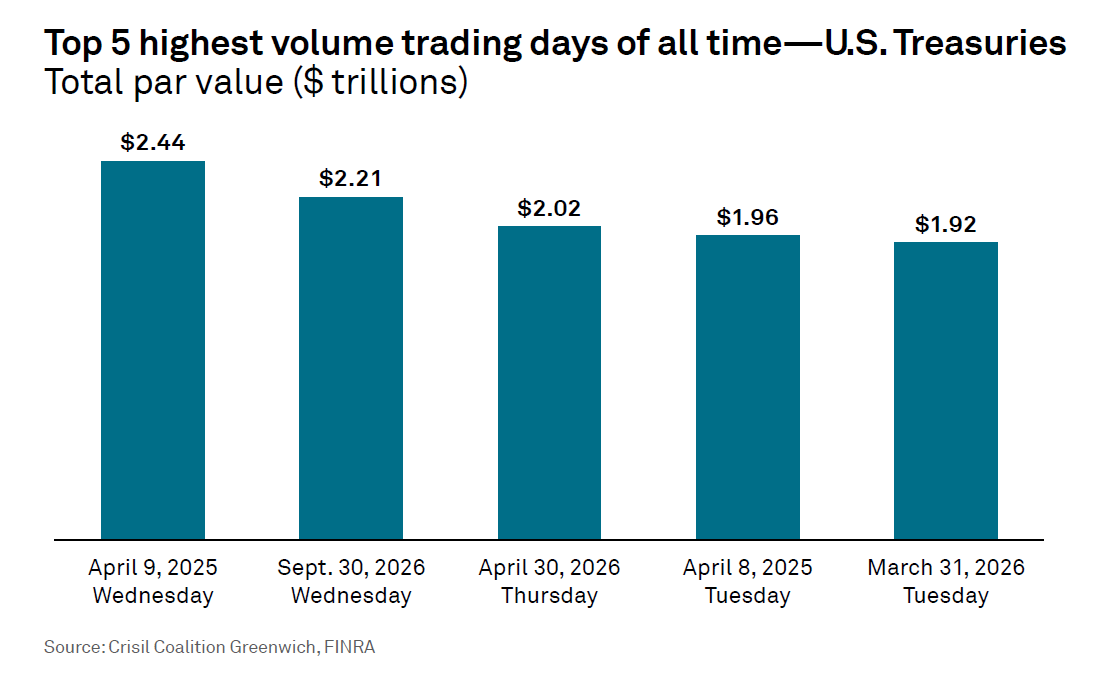
September 30 was the second-busiest Treasury trading day on record, with $2.21 trillion changing hands, behind the $2.44 trillion recorded on April 9, 2025 (see chart 2).
Chart 2: Top five highest-volume US Treasury trading days – total par value ($ trillions)
Source: Crisil Coalition Greenwich/FINRA
Average daily trade counts exceeded 506,000 in September, compared with 383,000 across 2025, while CME and FMX continued to report growth in Treasury and SOFR futures volumes and open interest.
"When cash Treasury volumes grow, futures volumes (and vice versa) grow because the markets are so closely tied together," McPartland said. "Over the long run, futures volume is about 90% of cash volume, and it has remained in the 90% to 100% range for quite some time."
He added: "Turnover is growing faster than the debt, so it is about more than just how much money the US is borrowing."
"Derivative volumes tend to grow when there is market uncertainty and volatility, and that is exactly what we have seen," McPartland said. "There is a lot of debate in the marketplace about the direction of interest rates and inflation, and divergent views can create a healthy futures market."
Regulatory uncertainty surrounds Treasury perpetuals
The introduction of Treasury perpetual futures remains subject to regulatory uncertainty, with Kalshi's proposed contract awaiting a CFTC decision.
McPartland pointed to the regulator's previous acceptance of perpetual futures in other markets as an indication that Treasury-linked products could eventually emerge.
"The CFTC has already approved a few perpetual futures. Although the Treasury perpetual future has been delayed and taken longer " he said. "That said, given the recent past, it seems inevitable that the contracts will come into being."
He identified legal challenges as a potential obstacle to their introduction.
"Legal pushback is probably the biggest short-term risk to getting those contracts launched," McPartland said.
However, he expects other venues to explore similar products if the market develops.
"US Treasuries are such a big market, often referred to as the deepest and most liquid market in the world. It only makes sense that people will enter what could become a new market," he said.
Looking ahead to 2027, he said macroeconomic conditions would remain the principal driver of Treasury futures activity despite increasing competition and product innovation.
"As much as I work in market structure and value innovation and competition, macroeconomic factors remain the primary driver," McPartland said. "It is about how the US government funds itself, and it will come down to fiscal and monetary policy, geopolitical tensions and inflation."
The developments follow Kalshi Prime's plans to expand into single-stock and Treasury perpetual futures, reported by FOW in October. The exchange operator is also developing foreign exchange and interest rate perpetual contracts, with its chief executive highlighting closer cooperation between the CFTC and Securities and Exchange Commission (SEC) as an important factor in bringing new products to market.