40% of market participants expect perps to boost futures trading - study
28th October, 2026

Four in ten institutional market participants expect perpetual futures to have a positive long-term impact on traditional futures markets, although regulatory uncertainty remains the biggest obstacle to wider adoption in the US according to research by Crisil Coalition Greenwich.
The research firm on Tuesday published a report that found that 40% of respondents expected the contracts to benefit futures markets, compared with 21% who anticipated a negative impact and 16% who expected limited disruption (see chart 1).
Chart 1: Perceived long-term impact of perpetual futures on futures markets
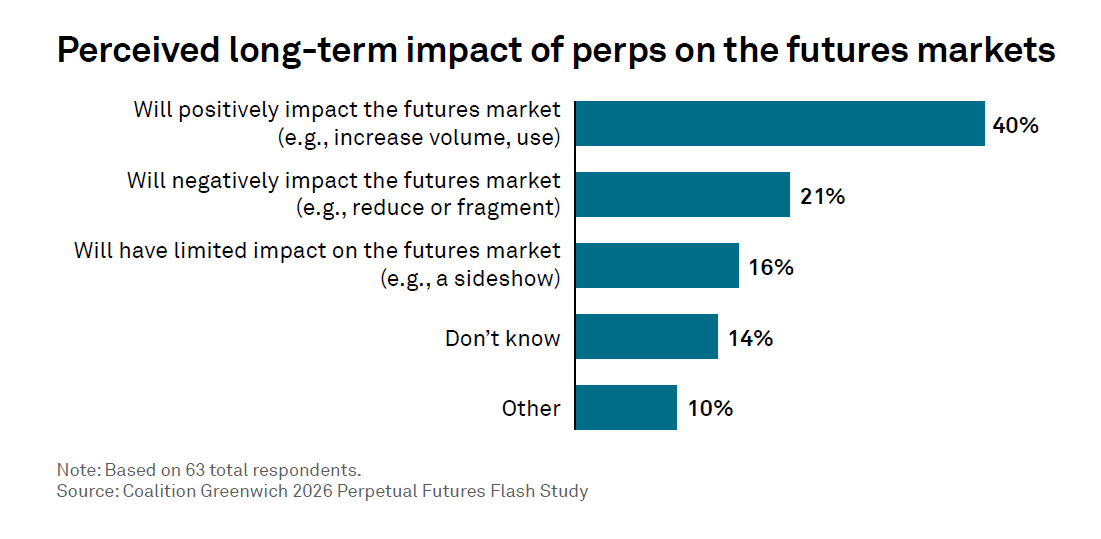
Source: Crisil Coalition Greenwich 2026 Perpetual Futures Flash Study
The findings are based on interviews conducted in September with 63 professionals from investment and trading firms, banks, brokers, exchanges and technology providers across North America and Europe.
Approximately 30% of respondents currently trade or have previously traded perpetual futures, while the remainder were familiar with the products.
Perpetual futures, commonly known as perps, are derivatives contracts without an expiry date, allowing traders to maintain market exposure without rolling positions into new contracts. Unlike conventional futures, the contracts typically use recurring funding payments between long and short positions to keep their prices aligned with the underlying market.
This comes as Kalshi applied to the CFTC last week for approval to launch a non-expiring crude oil futures contract linked to CME Group's WTI benchmark, following regulatory changes that opened a path for US exchanges to list true perpetuals.
Crypto and equities lead expected demand
Cryptocurrencies were identified as the asset class most likely to attract perpetual futures trading over the next two to three years, cited by 65% of respondents.
Equity index contracts followed at 51%, while 46% identified single-stock perps as a significant area of potential growth.
The study also highlighted emerging demand for contracts linked to computing capacity, with 40% of respondents expecting compute-related perps to attract trading activity (see chart 2).
Chart 2: Assets expected to attract the most perpetual futures trading over the next two to three years
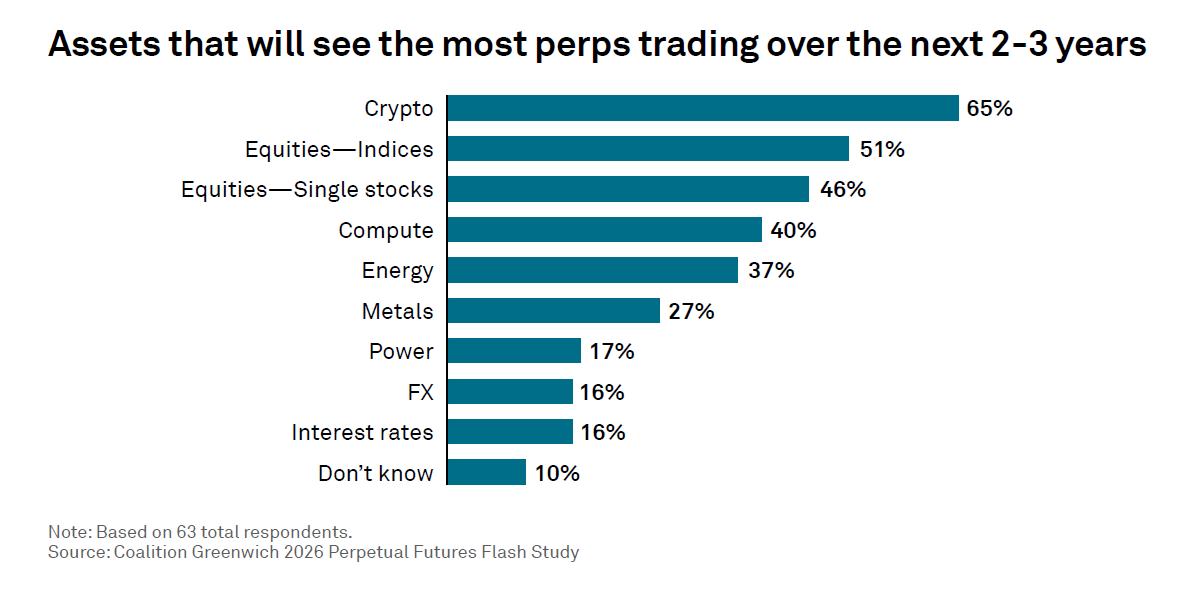
Source: Crisil Coalition Greenwich 2026 Perpetual Futures Flash Study
Energy was cited by 37% of respondents, followed by metals at 27%, power at 17%, and foreign exchange and interest rates at 16% each.
Crisil Coalition Greenwich said computing capacity could become an important market for perpetual futures as demand for artificial intelligence infrastructure creates new hedging requirements.
The report suggested that the ability to maintain exposure without rolling contracts could appeal to institutional investors managing equity market risk, while emerging asset classes could provide opportunities for exchanges to develop new derivatives products.
Regulatory uncertainty remains key obstacle
Despite the generally positive outlook, regulatory certainty was ranked as the most important factor that would increase respondents' willingness to trade perpetual futures.
The report highlighted the ongoing debate over whether perpetual futures should be classified as futures or swaps under US derivatives regulations.
The distinction could affect the trading venues, clearing arrangements and regulatory requirements applicable to the products.
Crisil Coalition Greenwich said resolving the classification debate would be important for institutional adoption, particularly as more trading activity moves from offshore cryptocurrency platforms towards regulated US markets.
The report also identified liquidity fragmentation as a concern, with market participants warning that the introduction of perpetual contracts alongside established futures could divide trading activity across competing products and venues.
Among respondents who identified negative consequences for traditional futures markets, fragmentation and the potential misuse or misunderstanding of the contracts by retail traders were the most frequently cited concerns.
The study also highlighted operational challenges, including the need for institutional trading and post-trade systems to accommodate contracts without expiry dates and funding arrangements that may require multiple payments each day.
Exchanges face opportunities and challenges
The research found that respondents anticipating positive effects expected perpetual futures to increase market participation, improve access to emerging asset classes and create new trading strategies.
Among the positive effects identified, 31% related to increased market participation, while 29% concerned improved access to emerging asset classes and 27% involved the development of new trading or investment strategies.
The report also suggested that established futures exchanges could respond by developing their own perpetual products, drawing on existing liquidity pools, clearing arrangements and margin efficiencies.
Crisil Coalition Greenwich said the long-term success of perpetual futures would depend on whether products developed largely in offshore cryptocurrency markets could be adapted to institutional requirements and US regulatory oversight.
The research was co-authored by Kevin McPartland, head of market structure and technology research, David Easthope, head of fintech, and Stephen Bruel, research director, at Crisil Coalition Greenwich.
The findings follow earlier Crisil Coalition Greenwich research published at the start of this month, which found that 73% of financial firms expect to increase derivatives market data spending over the next 12 to 18 months, driven by demand for real-time information, lower latency and AI-enabled trading workflows.