2025 Review: DTCC prepares for Treasury clearing rollout
23rd January, 2026

The Depository Trust & Clearing Corporation (DTCC) is at the center of efforts to ready the market for a shift to mandatory clearing of US Treasuries in the US, and the dominant cash clearing house has rolled out a series of initiatives ahead of the change.
The US Securities and Exchange Commission (SEC) has set December 31 2026, for mandatory clearing of cash transactions and June 30 2027, for repo transactions, marking a major market structure change for the vast market.
Speaking to FOW on major moves last year Brian Steele, the firm’s managing director and president of clearing and securities services said it is ready to absorb additional demand from the move.
2026 sees expanded US Treasury clearing mandates begin to roll out. How is DTCC supporting its clients through this process?
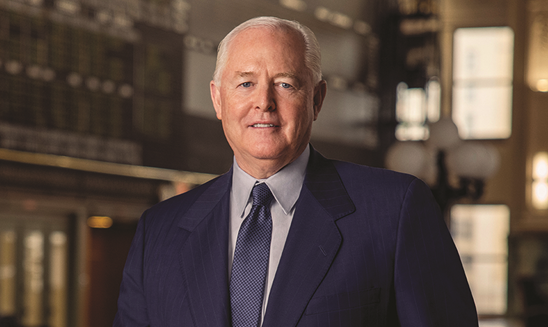
Brian Steele (pictured): The expansion of US Treasury clearing represents one of the most significant market structure changes in decades. We see this as an opportunity to reduce risk across the marketplace and deliver increased margin and liquidity efficiencies for our clients. We have several initiatives underway to support this objective. We also continue to introduce new access models to meet the diverse needs of market participant firms.
For instance, in late 2025, DTCC’s Fixed Income Clearing Corporation (FICC) introduced a new Collateral-in-Lieu service under our Sponsored General Collateral (GC) offering via BNY’s Global Collateral Platform. The service has been designed to reduce duplicative margin requirements for certain sponsored members and simplify operational workflows. In addition, following recent regulatory approval from the SEC, FICC will offer the Agent Clearing (ACS) Triparty Service to enable agent clearing members (ACMs) and their executing firm customers to access cleared triparty repo capabilities. The ACS Triparty service delivers enhanced margin efficiency, as ACMs can net margin across different Executing Firm Customers whose activity is held in the same omnibus account, provided they are not in a Segregated Indirect Participant Account.
Another example of our work in this area is our continued work with CME Group to extend our long-standing cross-margining arrangement to end-user clients. End-user clients would benefit from increased capital and margin efficiencies when trading U.S. Treasury securities and interest rate futures from CME Group that have offsetting risk exposures, because both clearing organizations would consider the net risk for margin calculations.
In 2025, FICC also processed record volumes, with its Government Securities Division (GSD) reaching a new overall peak volume of $13.2 trillion (£9.8 trn) on December 1 and buyside activity peaking at $3.1 trn across Sponsored and Agent Clearing Services on December 31. We will continue our efforts to advance our offerings, deliver efficiencies, meet market demands and help clients as they prepare for the implementation of the US Treasury clearing mandate.
How are you thinking about derivatives regulatory reporting? This has been a significant focus for market participant firms over the years.
The past few years have seen a wave of derivatives trade reporting regulatory rewrites around the world. Those changes have been accompanied by an increasing regulatory focus on the quality of reported data as well as efforts to simplify and harmonize the reporting process.
The EMIR Refit in Europe and recent reporting updates across Asia-Pacific have expanded reporting schemas and validation rules, raising the bar for testing, controls, and operational readiness. In North America, Canada updated its reporting rules last year, too. That’s a significant amount of evolution and change. On positive note, we are seeing a trend toward greater global regulatory alignment around a common set of derivatives trade reporting data elements – some 100 core fields that anchor over-the-counter reporting. This is an important step forward, and one that impacts market participant firms.
DTCC has invested in developing practical tools to help firms address this added complexity. Our cloud-based testing simulator enables clients to validate messages and data quality before submitting reports to production environments. Our Trade Reporting Analytics tool delivers quality assessment and peer benchmarking on reported data, providing firms with near real-time transparency and post reporting assurance. In the coming year, we are also planning to launch our new Approved Reporting Mechanism (ARM) to assist firms with MiFIR / MiFID II transaction reporting with greater efficiency and confidence through a combination of automated validations, exception management tools and comprehensive audit trails. We will also continue our educational and advocacy efforts to help clients navigate this ever-shifting environment.
Tokenization has moved rapidly up the industry agenda. How do you see that evolving this year?
2025 was a pivotal year for tokenization, both for the industry and for DTCC. After over a decade of industry experimentation and investment, 2025 saw increased adoption of blockchain technology, growth in the tokenization of real-world assets, and innovation to advance the digital asset ecosystem.
In December, DTCC’s subsidiary, The Depository Trust Company (DTC) received a no-action letter from the SEC staff to offer a service to tokenize real-world assets held at DTC. The initial scope of this work is focused on a defined set of highly liquid assets, including the Russell 1000, ETFs tracking major indices and US Treasury bills, bonds and notes. This milestone followed the success of our Great Collateral Experiment earlier in 2025, when our Digital Assets business demonstrated the technical feasibility of moving tokenized collateral between counterparties operating on different blockchain networks. That was proof that tokenization can materially improve collateral mobility and support new market models – even the potential for 24/7 trading.
This year we are focused on continuing to advance these efforts, ensuring that clients can capture the efficiencies of tokenization while avoiding fragmentation and ensuring safe, secure and resilient transactions, as evidenced in traditional markets today.
Related topics
Related Articles
All Insights21st October, 2026
DTCC warns of European settlement risks ahead of T+1 transition
Europe's transition to T+1 settlement in October 2027 could expose longstanding inefficiencies in post-trade processing, with new research from the Depository Trust & Clearing Corporation (DTCC) and ValueExchange finding that 68% of firms still rely on some manual trade matching.
Zak Jakubowski

21st October, 2026
MIAX launches four physically-settled fertiliser futures contracts
Miami International Holdings (MIAX) has launched four physically-settled fertiliser futures contracts on MIAX Futures, expanding its agricultural derivatives offering amid heightened volatility and supply-chain risks in global fertiliser markets.
Zak Jakubowski
21st October, 2026
OpenZeppelin, Chainlink partner to streamline digital platform
The collaboration removes integration friction for financial institutions and decentralised protocols moving assets onchain, offering a unified infrastructure that combines OpenZeppelin’s secure smart contract standards with Chainlink’s advanced cross-chain and compliance engines.
Aravind Bulusu