Middle East crisis: LNG supply shock shifts focus to Henry Hub index, US gas
2nd April, 2026

The surge in demand for liquified natural gas (LNG), driven by friction around the Strait of Hormuz has led to renewed thinking about the gas benchmark and risk management among Asian and European gas buyers, according to Timera Energy’s commentary published by CME Group.
The latest social media post by the Chicago-based exchange group on Wednesday stated that the Japan Korea Marker (JKM) and Title Transfer Facility (TTF) benchmarks have increased sharply to incentivise demand side balancing in LNG trade.
“European risk compounds this, with storages exiting winter at the bottom end of the five-year range and policy-driven injection mandates limiting one of the market’s key sources of flex.”
This eventually signals a shift in focus towards North America's Henry Hub (HB) index for efficient gas price discovery, though the JKM and TTF remain the two primary competing price benchmarks for global gas trading.
The European Commission in March last year proposed to extend the regulation on gas storage for two more years until 2027, considering its report on solidarity and gas storage.
Major amendments to the extended regulation include a two-month period to meet the 90% filling target every year during the winter season (October 1 to December 1), replacing the earlier November 1 deadline.
However, the Commission also stated that EU countries have the flexibility to deviate from the gas filling target in case of difficult market conditions or technical constraints, according to the European Commission's website.
The commentary said that there remains significant uncertainty around the length of the disruption, but regardless, the longer-term implications are understood.
“Buyers with JKM- or TTF-linked exposure are revising upward their expected long run average price of global gas linked contracts, as the Middle East disruption risk is now real and thus creates a much greater upside tail, reshaping the contracting calculus even if flows and spot prices normalise in the short term.”
The London-based energy consulting firm said buyers facing structurally higher and more volatile global gas benchmarks will reassess pricing formula to best reflect their risk appetite. “The repricing of risk will inevitably turn attention to indexation.”
Timera Energy opined that Henry Hub (HH), the primary benchmark for natural gas prices in North America, stands reasonably protected from the impacts of the global gas market dynamics.
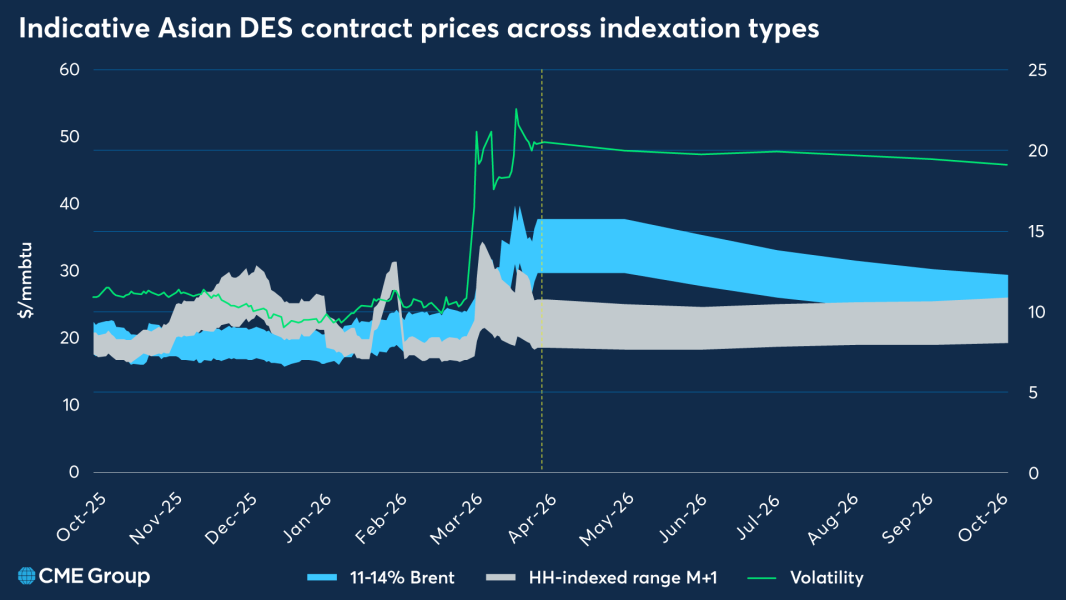
“The chart illustrates the three primary options. HH stands out given it has remained largely insulated from the impacts of global gas market dynamics. Brent linked contracts offer partial insulation from volatility through slope structures, but typically lacking the flexibility inherent in HH-indexed deals, even in DES (delivery ex-ship) structures,” the commentary read (see Chart 1).
Chart 1: Volatility in contract prices against indexation types
Source: CME Group
“The supply shock is likely to reinforce the structural case for HH indexation," noted the analysis.
As buyers look to hedge their risks arising from the geopolitical disruption, they will make sure to shift away from politically-exposed gas supply, and US-origin LNG stands as a direct beneficiary, the energy analytics firm said.
“Resultingly, portfolio players with short HH, long global gas positions from existing US LNG positions can draw on increased buyer appetite to physically hedge into the incoming supply wave, selling on a HH-indexed DES basis at attractive price levels in the secondary market,” the Timera Energy analysis read.
Meanwhile, a group of 11 trade bodies in March said the introduction of a price cap on natural gas threatens the efficient functioning of crucial derivatives markets.
National Stock Exchange of India this week partnered with the Indian Gas Exchange to launch natural gas derivatives, marking India’s first domestic benchmarked energy derivatives contract that serves as an efficient risk management tool.
Related topics
Related Articles
All Insights20th May, 2026
Stellar integrates Circle’s onchain infrastructure to improve USDC transfers
The US-based decentralised blockchain said Circle Cross-Chain Transfer Protocol (CCTP) has gone live on its network, enhancing USDC transfers to and from the Stellar ecosystem.
Aravind Bulusu

20th May, 2026
Kaiko acquires Cometh to expand regulated onchain infrastructure
The French data and analytics firm has acquired decentralised finance (DeFi) infrastructure provider Cometh to integrate the company’s blockchain engineering capabilities and regulatory credentials into its existing stack.
Aravind Bulusu

20th May, 2026
SGX, BOC deepen partnership to boost Singapore-China-ASEAN collaboration
The expanded collaboration aims to deepen offshore Renminbi (RMB) market development, broaden access to the Asian exchange’s derivatives suite and support cross-border capital flows.
Narayani Srinivasan