Understanding Financial Derivatives & Trading
Financial derivatives are types of contracts often used to help traders manage risk, ‘hedge’ against future price movements, and speculate on the direction of the market.
Here, we will look at what they are, with a focus on futures and options, how they work, and their importance.
What are derivatives?
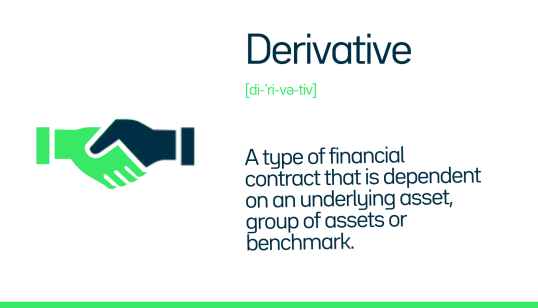
Derivatives are financial contracts linked directly to the value of an underlying asset, group of assets or benchmark. These underlying assets can include stocks, bonds, commodities, currencies, interest rates, market indexes and now, cryptocurrencies.
Derivative contracts can be relatively straightforward or very complex. In all cases, the terms of each derivative contract clearly state how the parties to the contract will respond to future changes in the value of the underlying asset.
Financial derivatives may be traded on exchanges (exchange-traded or listed derivatives) or ‘over the counter’ (OTC derivatives).
What are the different types of derivatives?
There are four main types of derivatives, and they fit into two classes: lock and option.
Futures, forwards and swaps are all lock products, meaning that they bind the parties to the terms agreed upon for the length of the contract.
Option products differ in that they offer the holder the right to buy or sell the underlying asset or security at a given price on or before the option’s expiration date.
What are Futures and Options?
Futures and Options are two types of derivatives. They are financial instruments (contracts) based on the premise that one party to a contract will, at a specified future point in time, deliver goods to the other party in return for cash. These ‘goods’ might take the form of shares, government bonds, currency (including cryptocurrency) and commodities (e.g. barrels of oil or coffee beans).
Futures and Options are both standardised contracts traded primarily on exchanges. They differ in that futures are lock products whereas options aren’t – there’s an opportunity to buy or sell rather than an obligation. Both can be used to hedge or speculate on the price of an underlying asset.
Futures
A Future is a contract (binding commitment) to buy a standardised unit of a commodity, or financial instrument (underlying asset), at a specified date in the future.
Options
An Option gives the buyer the right, but not the obligation, to buy (call option) or sell (put option) a specified volume of an underlying asset at a specified price at a future date. The option is for physical delivery or cash settlement.
Who uses Futures & Options?
Futures and Options are used to ‘hedge’ against future price movements in physical goods, for example by power companies and manufacturers. They are also used by financial firms (including traders, brokers and fund managers) seeking to profit from future price movements by ‘speculating’ on the direction of those movements (in either direction). In this case, there is no interest in ‘owning’ the underlying asset, simply to make a profit from positions taken.

Why trade Futures and Options?
In the derivatives market, both instruments create the ability to fix a future price at which commodities and financial assets can be bought (or sold).This can help businesses to protect themselves from volatility in the cost of underlying goods and commodities (like fuel) that may materially impact their business performance e.g. manufacturing companies.
Futures and Options are also used by financial firms as a speculative investment based on taking a view on the future direction in the price (value) of an underlying asset. The primary advantage of trading in listed derivatives rather than buying (or selling) the underlying asset is that with a derivative instrument both parties to the contract must secure the investment with a margin (deposit) that represents a small percentage of the total value of the position held, which is adjusted to reflect movements – up and down – in that total value.
If the value of an ‘open’ position moves up or down by more than the value of the margin, the party on the ‘losing’ side must increase the deposit to cover the position. As such, while the ‘deposit’ is smaller than would be required to secure the future purchase of a physical asset, there is the potential to lose a great deal more if the value of the position continues to move in the ‘wrong’ direction.
Some derivatives, often those that are over the counter can be riskier than others. Before you make any decisions, it’s important to consider the level of risk you’re comfortable with.
How do you trade Futures and Options?
Futures and Options are typically bought and sold through an intermediary – a bank or non-bank broker such as a market-maker or Futures Commission Agent (Merchant) – or other direct member of the exchanges on which the specific Futures and Options instruments are listed (e.g. CME and CBOE). To ensure against the default of any trading counterparty, margins (deposits) are held by Clearing Houses.
You can keep up to date with all the regulatory news in the futures and options industry, with timely insights, data tracking activity, and in-depth analysis of the issues moving the market with FOW's Market Intelligence. If you’re looking to minimise trading risk, trusted reference data is essential. FOW Reference Data provides it to support operational accuracy and market connectivity across the front, middle, and back office.
What is a Futures Exchange?
Future exchanges establish standardised contracts for trading on their trading venues, and they usually specify the following: assets to be delivered in the contract, delivery arrangements, delivery months, pricing formula for daily and final settlement, contract size and price position and limits.
All activity on Futures Exchanges in terms of volumes traded and contract values are transparent.
What is a Clearing House?
An organisation that registers, monitors, matches and guarantees trades on a futures/options exchange and carries out the financial settlement of those trades. Clearing houses also manage the margins required to be placed by buyers and sellers to maintain open positions for the duration of contracts.
Clearing is the process of formally ‘consummating’ a trade by delivering the assets to the buyer and funds to the seller.
History of Derivatives
Explore the intriguing origins and evolution of derivatives, from their roots in ancient civilisations to their transformation into the sophisticated financial tools of today.
From Mesopotamia to the bustling markets of Renaissance Italy and the emergence of organised exchanges in 19th century America, explore how derivatives trading has shaped economic landscapes over the millennia.