Operational development essential for Hong Kong market infrastructure: FIA Hong Kong
24th April, 2026
By removing market friction and refining products, Hong Kong can amplify its role as an offshore derivatives hub for China and a gateway between China and the world.
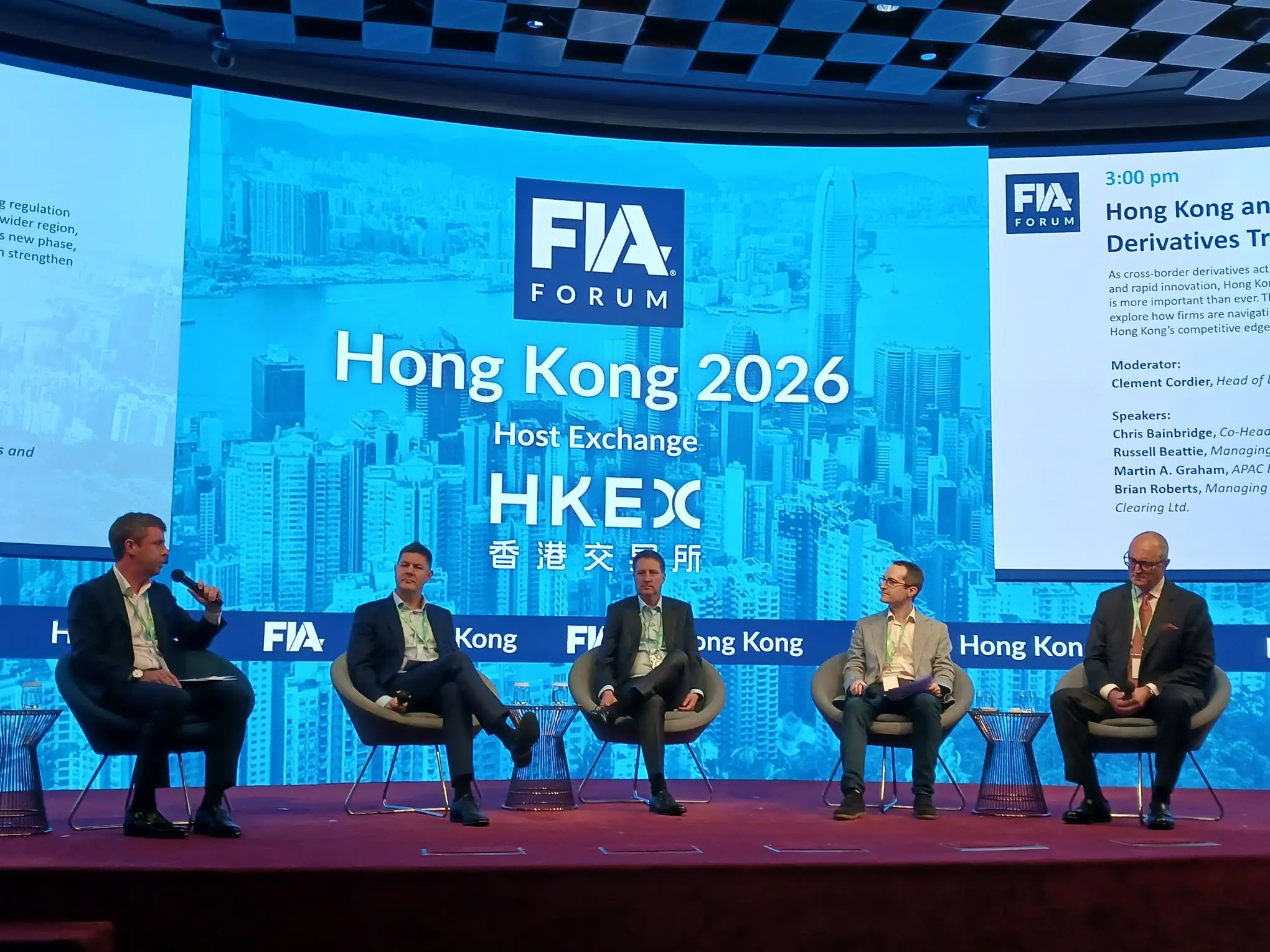
Speaking at the FIA Hong Kong Forum on Thursday, panellists highlighted the role of Hong Kong as a conduit between China and the world, and how it can build on its strengths through incremental innovation in products.
Chris Bainbridge, co-head prime services & clearing, Asia-Pacific at SG Securities (HK), said that Hong Kong's strengths lie in price transparency and depth, allowing investors to express the risk that they want through its four key products: equities, ETFs, futures and options.
Bainbridge said: "Clients value clearing and trading certainty and are willing to forego basis risk to access deep liquid markets over trying to find the perfect hedge."
By capitalising on its strengths such as account segregation and netting efficiency, HKEX is well positioned to cater to event driven risk, especially as it looks to expand its shorter dated products through zero-day options.
"For Hong Kong, it's more about the infrastructure and how to remove frictions in the market and less about having shiny new products," said Bainbridge.
Through the Orion Derivatives Platform, coupled with incremental innovation in products such as extending trading hours and reducing tick sizes, Bainbridge believes that these initiatives together will make Hong Kong attractive to global investors.
"Making things operationally easy will need to be the focus of innovation," he said.
Looking ahead, Bainbridge highlighted clearing efficiency, collateral mobility through tokenisation and real time risk visibility as defining factors for whether Hong Kong can remain competitive.
Brian Roberts, managing director, head of equities product development, Hong Kong Exchanges and Clearing, reflected on the success of the Bond Connect and Stock Connect schemes and the increasing importance of Hong Kong as the offshore derivative hub for China.
Roberts said that trading hours extension is a key focus for regional exchanges in APAC such as HKEX as they grapple with US exchanges such as Nasdaq implementing 23/5 trading.
Due to increased event risk, Roberts noted the importance of precision hedging through zero day and weekly options as well as thematic and sector focused derivatives such as biotech to meet hedging demands of investors.
As the largest offshore RMB centre, Hong Kong also offers big opportunities in fixed income in addition to the development of commodity markets.
Reflecting on the role of Hong Kong vis a vis China, Russell Beattie, managing director, Asia Pacific, CME Group, said: "We can't look at China and Hong Kong in isolation and vice versa."
The onshore market in China is seeing consolidation in futures companies, with the current 151 which is expected to go down to around 50 firms.
"The AA rated firms are looking to set up and Singapore and Hong Kong," he said. "By acting as the conduit for outbound activity, Hong Kong is being embraced as a twin financial centre by China in addition to Shanghai."
CME Group has made strategic bets, having increased its hires in Hong Kong to create its second largest hub in Asia Pacific.
"In 2025, 63% of traded volume happened in Asia Pacific exchanges so we want to capture the significant growth," he said.
He noted that the last two quarters have seen an "explosion in commodity products" as volumes for Asia outperformed its global counterparts.
"China and Hong Kong are driving significant growth as investors seek increased level of depth and liquidity in the Asian time zone," he said. "Instead of moving to the western hemisphere, investors will come to the Asian time zones for diversification, which is why we're investing in the region for the long term and building partnerships to link up global liquidity pools."
Offering his perspective on derivatives regulation in China, Martin Graham, APAC head of government & regulatory policy, Citadel Securities, said that for the last two years, there has been a strong focus on accountability, as exemplified by the China Securities Regulatory Commission's (CSRC) consultation on derivatives trading which was released in January.
Cross border data flow is another strong focus.
"In order to trade accurately, investors need proper data but it has been a contentious area as to what can be transferred in and out of China and how," said Graham.
Algorithmic and programme trading rules are also an area to keep an eye on as the CSRC looks to extend its regulatory reach.
"The focus is when a trade hits the market, what is its impact from a suitability perspective," said Graham. "Supervision is not just at the execution level but is now moving up the value chain and we'll will see the move towards examining why an algorithm behaves in a certain way before it hits the market."
Related topics
Related Articles
All Insights8th June, 2026
US exchanges lead week's futures launches
MIAX prepares to launch a Bloomberg equity index future as CME expands its crypto benchmark offering, while Coinbase adds new perpetual-style products.
Zak Jakubowski

5th June, 2026
BoE and FCA review finds no duplication in market infrastructure supervision
UK regulators highlighted cooperation on tokenisation, T+1 settlement and clearing market reforms following their annual review of supervisory arrangements.
Zak Jakubowski

5th June, 2026
SEC’s Jamie Selway warns against ‘unhealthy leverage’ amid regulatory harmonisation
The Securities and Exchange Commission’s (SEC) director of trading and markets division said successful harmonisation between the SEC and the Commodity Futures Trading Commission (CFTC) requires avoiding historical mistakes like extending unhealthy levels of leverage to consumers.
Aravind Bulusu