Higher liquidity drives more advanced trading strategies in Indian derivatives markets
24th February, 2026

An executive at an Indian broker outlines the factors driving a strong year of growth for Indian index and single stock derivatives.
Rishi Kumar, senior vice president, clearing services at Globe Capital Market, said that 2026 represents a year of earnings-led market expansion, rising liquidity, deepening participation and improved market microstructure for Indian equity markets.
“These conditions support both directional strategies and volatility-based trading frameworks across index and single stock derivatives,” he said.
Domestic capital flows have emerged as the most powerful stabilising force for Indian equity markets, noted Kumar.
While foreign institutional investors have periodically reduced exposure, domestic institutional investors and retail participants have consistently absorbed supply - ensuring market continuity and liquidity.
According to Kumar, the Indian equity market is transitioning into an earnings-driven growth phase.
“After several years of valuation re-rating, future returns are increasingly anchored in corporate profit expansion rather than multiple expansion,” said Kumar. The outlook for 2026 remains firmly anchored in fundamentals.”
Financial services, consumption, industrial manufacturing, capital goods and select technology segments are expected to lead earnings growth.
This environment is structurally positive for derivatives markets.
“The market is expected to transition into a phase of consistent earnings compounding, with projected earnings growth of approximately 10 to 12% annually between FY26 and FY27,” said Kumar.
With the Nifty currently trading in the range of 22 to 23 times trailing 12-month earnings, valuation comfort will increasingly depend on earnings delivery rather than liquidity-driven multiple expansion, added Kumar.
“Earnings visibility improves directional confidence for futures traders, while stable growth expectations contribute to moderate volatility regimes that are conducive to structured option strategies,” he said.
The equity derivatives market has undergone rapid structural expansion over the past five years.
Participation has broadened across institutional investors, proprietary trading firms and sophisticated retail participants.
Daily turnover and contract volumes have scaled sharply, supported by technological infrastructure, weekly expiries, new product introductions and lower transaction costs.
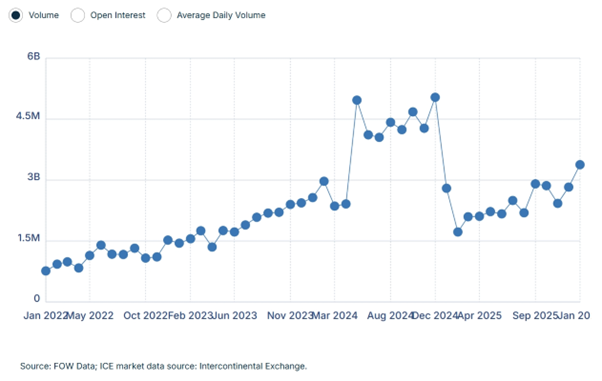
According to FOW data, Nifty 50 options volume on NSE saw 3.37 billion contracts in January 2026.
Chart 1: Nifty 50 options on NSE
Source: FOW data
“Higher liquidity has improved execution quality, narrowed bid-ask spreads and reduced market impact,” said Kumuar. “This enables more advanced trading strategies, including high-frequency market making, gamma scalping, volatility arbitrage and calendar spreads.”
The increasing depth of the market also supports efficient risk transfer and portfolio hedging.
Despite the positive structural outlook, traders must remain cognisant of several risk factors.
“Global macro shocks, geopolitical events, sudden inflation spikes and abrupt capital flow reversals can lead to sharp volatility regimes,” said Kumar.
Regulatory changes in margin frameworks, contract specifications or product structures can alter market dynamics, he added.
Retail-driven participation may also create localised volatility spikes and short-term price distortions.
“For professional traders, the key opportunity lies in aligning macroeconomic signals with market microstructure dynamics to systematically capture directional trends, volatility inefficiencies and liquidity premia in one of the fastest growing derivatives markets globally,” said Kumar.
Related topics
Related Articles
All Insights25th May, 2026
Bybit’s Ben Zhou highlights innovation, institutional trust key for tokenisation era
The Dubai-based crypto exchange’s chief said compliance, licensing, institutional trust, and global distribution capability become real differentiators as digital asset industry evolves beyond trading-focused platforms.
Aravind Bulusu

25th May, 2026
SEC’s ‘innovation exemption’ delayed after review of draft plan-report
The US markets regulator is delaying a plan to provide broad exemptions for US crypto firms to trade tokenised assets linked to stocks, Bloomberg reported, citing people familiar with the matter.
Aravind Bulusu

25th May, 2026
OKX launches perps on ICE Brent Crude, WTI benchmarks
The California-based cryptocurrency exchange launched perpetual futures based on Intercontinental Exchange’s (ICE) Brent Crude and WTI Crude energy benchmarks.
Aravind Bulusu