Banks and trading firms flag concerns over transparency and post-Brexit rules
15th May, 2026

Industry respondents highlighted concerns over regulatory transparency, coordination and competitiveness in PRA survey.
Banks and trading firms on Friday have raised concerns about transparency, regulatory coordination and the cumulative impact of post-Brexit prudential reforms, according to the latest annual industry feedback survey published by the Prudential Regulation Authority.
The 2025 Firm Feedback Survey showed firms gave some of the lowest scores to questions covering the PRA’s cost-benefit analysis, coordination with other regulators and whether the regulator’s approach makes the UK an attractive place to do business.
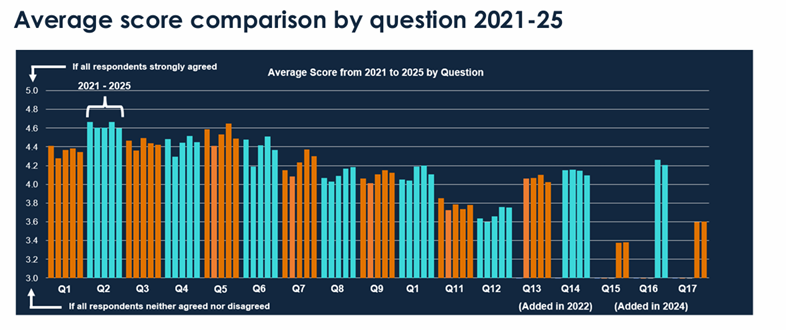
Among the weaker scoring areas was Question 15, which asked firms whether “the PRA undertakes high quality cost benefit analysis to inform its rule-making”, while Question 17 asked whether “the PRA’s actions, effectiveness, and approach to proportionality, make the UK a more attractive place to do business”.
The results point to continuing industry concerns around the cumulative burden of UK regulation as policymakers pursue post-Brexit reforms aimed at improving the competitiveness of London markets.
The PRA said feedback from firms highlighted recurring demands for greater transparency, improved regulatory coordination, more proportional supervision focused on key risks and better forward visibility of supervisory timelines.
“Firms want unambiguous feedback as well as clarity around the rationale for supervisory work and data requests,” the regulator said in its summary of responses.
The regulator added that firms also wanted “improved co-ordination, both between supervision teams and specialists and between the PRA and the FCA and international regulators”.
Cross-border coordination and overlapping supervision have become increasingly important issues for banks, clearing houses and trading firms following Brexit and the emergence of divergent UK and EU regulatory frameworks across derivatives, clearing and capital markets.
Recent survey data also underlined the gap between firms’ views on supervisory engagement and their concerns over regulation and policy. Average scores for questions relating to regulatory framework, coordination and competitiveness remained consistently below those for supervisory relationships and communication across the 2021-2025 period (see Chart 1).
Chart 1: Average score comparison by question 2021-25
Source: Bank of England
Chart data published alongside the survey showed regulatory framework, rules and policy scored consistently below areas such as supervisory understanding of firms and relationships with supervisors. Coordination with other regulators and data requests also ranked among the weaker categories.
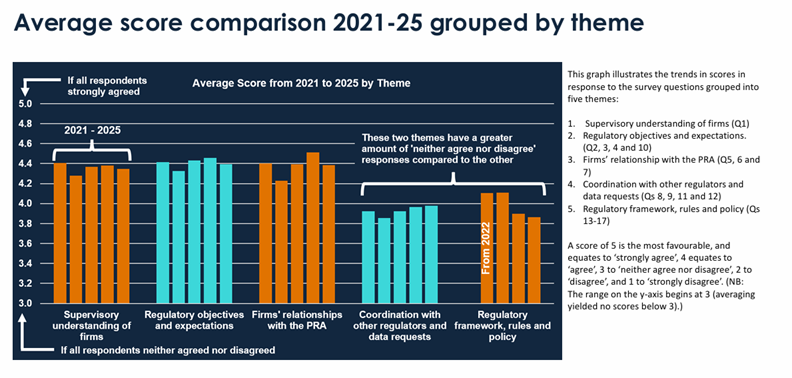
The PRA acknowledged that “scores relating to the PRA’s regulatory framework, rules and policy were lower than the other themes surveyed”, although it noted the section also attracted a comparatively high number of “neither agree nor disagree” responses.
Broader analysis in the report showed firms continued to rate the PRA relatively strongly on supervisory engagement and understanding of firms’ business models, while prudential rules, policy and regulatory coordination lagged other categories surveyed (see Chart 2).
Chart 2: Average score comparison 2021-2025 grouped by theme
Source: Bank of England
The PRA said firms provided “the most positive scores for the PRA’s articulation of regulatory objectives and expectations and for the effectiveness of their relationship with the PRA”.
“In particular, firms provided positive comments on the approachability, responsiveness, and professionalism of supervisory teams,” the regulator added.
The PRA said it is continuing initiatives including its Strong & Simple framework and Future Banking Data project as part of efforts to improve proportionality and streamline regulatory data collection.
The findings come amid broader debate over the UK’s competitiveness as policymakers seek to attract investment in areas including financial technology, digital assets and artificial intelligence while maintaining consumer protections and financial stability safeguards.
In April, the Bank of England (BoE) warned that artificial intelligence is increasingly being deployed in trading and credit risk assessment, with firms expanding its use into functions that directly shape market behaviour and liquidity conditions.
Related topics
Related Articles
All Insights29th June, 2026
TT launches new tools for derivatives trade surveillance
The Chicago-headquartered fintech firm said its Market Replay tool and enterprise-level case management user interfaces improve the workflow, speed and scope of surveillance cases across asset classes.
Aravind Bulusu

29th June, 2026
Nomura inks deal with Circle to explore on-chain finance
The Tokyo-based financial services group said it will consider opportunities in stablecoin-based instant settlement and examine ways to enhance collateral management, fund transfers, and capital markets transactions using blockchain.
Aravind Bulusu

29th June, 2026
EBA consults on setting fines under MiCA
The consultation sets out the EBA’s proposed approach to calculating fines where an issuer of significant tokens, or a member of its management body, has negligently or intentionally committed an infringement.
Karry Lai