GMEX – going to eleven?
19th February, 2015
Will compliance on buy-side understand let alone approve Gmex concept?
The announcement that new derivativesexchange GMEX has received investment from SocGen reopened the debate here asto the future of rates trading and who the likely winners are going to be.
Reliable data is hard to come by on exactly what is happening to over-the-counter volumesand where they are going. Such evidence as does exist seems to show a steadyincrease in Swap Execution Facility volumes, although this is masked by several anomalies,including volume which is still transacted manually but reported to look likeelectronic volume.
Venues like Eris, which offer swap futures, also report steadily rising volumes too.
Some things are becoming clearer, however.
When a buy-side is looking to hedge a particular period on a rate curve, itwill be able to select from a range of different but economically similarinstruments. At one end of the spectrum are regular futures, which are cheapestand easy to understand, but lack precision in terms of start and end dates.
Atthe other end will be custom OTC contracts which, conversely, are the mostexpensive but can be matched precisely to a client’s exact requirement.
The question that remains, then, is whathappens in the middle? With its launch of swap futures, the LSE is showing howit thinks it can offer the optimum blend by allowing users to offset marginwithin its existing pool of OTC open interest held at SwapClear.
But, toparaphrase Spinal Tap’s Nigel Tufnel, Gmex aims to “go to eleven” by offeringthe convenience of a future and yet the precision of a swap. The challenge, ofcourse, will be whether compliance folks in the buy-side understand – let aloneapprove – the concept. It may just be less hassle for them to go to the regularfutures market instead.
Education of the buy-side, therefore, willbe a critical success factor for new venues. This was the case in Europe, withthe rise of the multi-lateral facilities (MTFs) in the cash equities world. Without natural liquidity, high frequency trading folks like Virtu will be left twiddling their thumbs. The crucial lesson, then,is that to be successful, any new venue needs a mixture of participants in thesame way that ecosystems in nature support and require a mix of participantstoo.
By Steve Grob Fidessa Fragmentation index
http://fragmentation.fidessa.com/2015/02/19/gmex-–-going-to-eleven/
Related Articles
All Insights3rd June, 2026
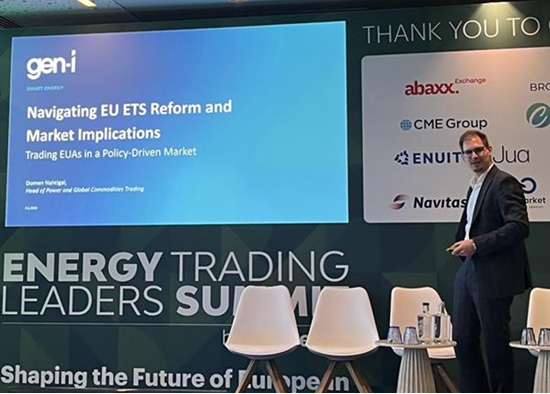
Carbon traders rethink risk management ahead of July EU ETS review
Upcoming reforms to the European Union Emissions Trading System (EU ETS) could reshape carbon market dynamics and force traders to focus more heavily on policy scenarios, according to a senior carbon trader.
Zak Jakubowski
3rd June, 2026
SEBI’s ‘dividend cap’ on clearing houses traps excess capital without benefit - expert
A plan to cap the dividend earned by stock exchanges from their clearing subsidiaries is reportedly under consideration by a panel constituted by the Securities and Exchange Board of India (SEBI), according to a report by Economic Times.
Aravind Bulusu

3rd June, 2026
Marex opens Japan office in APAC push
The London-based brokerage and clearing firm has launched operations in Japan, marking a significant expansion of its Asia Pacific strategy and strengthening its presence in one of the region’s most established capital markets.
Narayani Srinivasan