ANALYSIS: Asian exchange chiefs weigh in on retail participation - FIA Asia
4th December, 2025
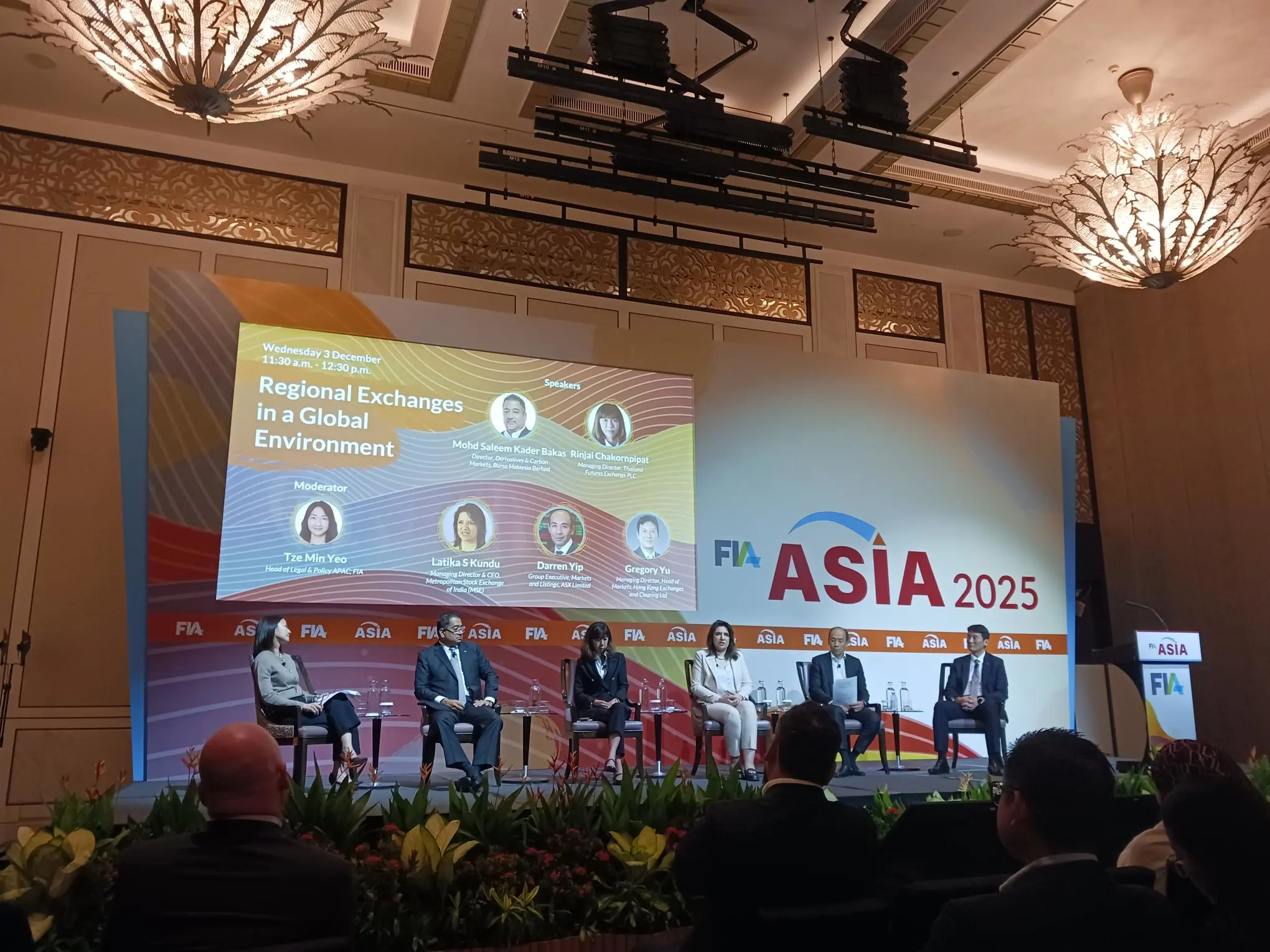
Asian regional exchange executives explore the implications for exchanges as the focus on retail participation amplifies.
Speaking at the FIA Asia 2025 conference in Singapore on Wednesday, a panel of regional exchange leaders shared insights on what it means for exchanges as retail participation comes to the fore.
Rinjai Chakornpipat, managing director at Thailand Futures Exchange, noted that for the Thailand market, retail investors make up between 40 to 50% of the market while the rest comprises foreign institutions.
“We need quality market makers to build liquidity and it’s important that instead of mass retail contracts, we design contracts that are tailored to the Generation X, Y and Z investors, and help develop professional retail traders much like prop trading firms,” she said.
For equity investors, particularly older participants, Chakornpipat said that they’re looking for hedging tools to manage portfolios but not necessarily frequently trading.
“There’s an opportunity to expand the investor base and cross-selling futures products to equity investors,” she said. “The key is how to keep them in the market through education and collaboration with intermediaries.”
Speaking about the India market, Latika Kundu, managing director and chief executive at Metropolitan Stock Exchange of India, said that as the newest exchange in the biggest democracy in the world, it’s focused on tapping untapped potential.
“We need to create an environment so that markets are robust and scalable,” she said. “Awareness building plays a key role as the next generation moves from saving to wealth creation.”
Reflecting on the doubling of retail participation in the last 10 years, the key contributing factor has been the growth of the Indian market economy and a mind shift for diversification in capital markets.
She added that through mutual fund accounts, it’s helped to bring more people to the Indian capital markets but there remain ample opportunities to increase participation.
Looking back on the shift to T+1 settlement two years in, Mohd. Saleem Kader Bakas, director, derivatives and carbon markets at Bursa Malaysia, said that while there was resistance from traders at the beginning, the shift has allowed for better management of their portfolios.
For the Malaysian market, Bakas said that it’s made up of 40% domestic participants, of which is 20% retail.
To broaden the professional retail investor base, the exchange has developed a futures trading apprenticeship programme through a capital market development fund. He said that more than 5000 applicants have applied for 30 seats. So far, there have been six intakes and about 35% of participants covert to traders.
Speaking about the Hong Kong market, Gregory Yu, managing director, head of markets at Hong Kong Exchanges and Clearing, said that while the market is made up mostly of institutional investors, there has been growth in the retail segment for micro contracts as well as covered call ETFs.
He noted untapped opportunities for Southbound trading from mainland China, particularly through the ETF Connect programme.
Darren Yip, group executive, markets and listings at ASX, highlighted opportunities for the exchange to introduce shorter term products, such as daily options as well as event driven derivatives related to the energy transition.
“With one-third of Australian homes having installed solar installations, the country could be a producer of carbon credits,” he said. “This means changes in the demand and supply for the grid, with opportunities around electricity peak contracts, regional gas contracts as well as overnight futures to handle secondary demand from electric vehicle charging.”
Related topics
Related Articles
All Insights3rd June, 2026
Carbon traders rethink risk management ahead of July EU ETS review
Upcoming reforms to the European Union Emissions Trading System (EU ETS) could reshape carbon market dynamics and force traders to focus more heavily on policy scenarios, according to a senior carbon trader.
Zak Jakubowski
3rd June, 2026
SEBI’s ‘dividend cap’ on clearing houses traps excess capital without benefit - expert
A plan to cap the dividend earned by stock exchanges from their clearing subsidiaries is reportedly under consideration by a panel constituted by the Securities and Exchange Board of India (SEBI), according to a report by Economic Times.
Aravind Bulusu

3rd June, 2026
Marex opens Japan office in APAC push
The London-based brokerage and clearing firm has launched operations in Japan, marking a significant expansion of its Asia Pacific strategy and strengthening its presence in one of the region’s most established capital markets.
Narayani Srinivasan